The Illinois Attorney Review Period: The Five Business Days After Your Offer Is Accepted
Your offer was accepted and the contract is not final yet. What happens in the next five business days decides how much room you have for everything that comes after.
By Vito LiRosi · Realtor and licensed home inspector · September 2026
Five business days, and most of what matters happens in the first two.
Five business days, and the clock starts the business day after everyone signs. It is a contract clause, not an Illinois statute, and what you can win in it depends on getting an inspector into the house in the first forty-eight hours.
- The price and the closing date are off the table. The standard modification clause carves them out, so asking to reopen the price wastes the window.
- The inspection runs at the same time, not after. Book it the day the contract is signed or you will be negotiating on day five with nothing in writing.
- There is a second five-day clock, and it is statutory. A material defect disclosed on a report delivered after signing gives the buyer five business days to terminate and recover the earnest money.
- Silence binds you. If no notice is served inside the period, the contract stands as written and nobody sends a reminder.
Your offer was accepted. The sign says under contract and everyone has congratulated you. The contract is not final yet, and for the next five business days it can still be changed, extended, or ended without costing you a dollar. This is the Illinois attorney review period buyers get, and it is the last stretch of the deal where you have real room to move.
Most of what is written about it stops at the rule. Five business days, the attorneys look at it, here is the clause. That is accurate and it is not much use at seven in the evening when you have a quote in your hand and you are trying to work out whether to ask for it. What follows is the window from the buyer's side: what moves, what does not, and where the week gets lost.
One thing up front, said once. I am a Realtor and a licensed home inspector, not an attorney. Every question that turns on the language in your specific contract belongs to your own attorney, and you should have one before you write an offer.
What is the Illinois attorney review period, and what are the five business days?
Start with the thing almost nobody says plainly: this window is not an Illinois law. It is a clause in the contract you signed. The standard Multi-Board residential contract used across Chicago and the suburbs carries an attorney modification provision, and that is where the five business days come from. A deal written on a different form may not have one at all.
That matters more than it sounds. Because the window is contractual, it lives on what the contract says, including how the days are counted. The count starts the business day after the last party signs, and weekends and federal holidays are not business days. A contract signed late on a Friday before a Monday holiday does not start running until Tuesday, and its five days can stretch across most of two calendar weeks.
What the window is for is narrower than buyers assume. It exists so an attorney can read the contract and fix it. It is not a free look and it is not a cooling-off period.
Three things your attorney can do
- Approve it as written. The contract becomes binding and the deal moves on to inspection, financing and title.
- Propose modifications. This is what almost always happens: written changes go over, the other side's attorney responds, and the two negotiate until they agree or the window closes.
- Disapprove it. Under most versions of the clause a disapproval ends the contract and the earnest money comes back.
Here is the misunderstanding worth correcting. Disapproval is not a threat you hold over a seller to win a repair. It is an ending. Attorneys use it when something structural to the deal is wrong, and using it as a bargaining move risks a seller who accepts the ending and goes back to the offer behind yours. In a house with three offers on it, that is not theoretical.
What can a buyer ask for?
Two things are usually carved out of the modification clause: the purchase price and the closing date. Those are the terms the parties already agreed on, which means an attorney-review request to knock money off because you had second thoughts is not a request the clause supports, and experienced listing agents know it.
What does move, routinely: closing and possession logistics, the amount and timing of the second earnest money deposit, the survey, who pays for what among the items the contract leaves open, how appliances and personal property are described so there is no argument on walkthrough day, the response deadlines themselves, and language tying a repair or a credit to something found on inspection.
How much moves depends on the seller's position, and you can read it before you ask. A house that sat sixty days, a seller who has already bought their next place, an estate or a relocation with a deadline: those sellers give. A house that went under contract in a weekend with backups behind it gives very little, and a long list of small requests there reads as a buyer looking for an exit. Pick the two things that matter and let the rest go.
The second clock nobody tells you about
There is a separate five business day window in Illinois that is a statute, and it has nothing to do with attorney review.
The Residential Real Property Disclosure Act requires a seller to deliver the written disclosure report to the buyer before the contract is signed. If a seller discloses a material defect on that report and, in violation of that requirement, hands it over after all parties have already signed, the buyer has five business days after receiving the report to terminate the contract and get back every earnest money deposit and down payment, with no liability to the seller and no recourse by them. If the seller never provides the report before the property is conveyed, the buyer has the right to terminate. On the other end, no action for a violation of that Act can start later than one year from the earlier of possession, occupancy, or the recording of the conveyance.
The practical point is timing. That clock runs on its own terms whether or not attorney review has closed. Tell your attorney the date you received the report, in writing, the day you receive it. For what the report is worth once you have it, and what an unchecked box does not prove, I wrote a separate piece on red flags when buying a house.
The honest take
The five business days are not really an attorney problem. They are a scheduling problem. Buyers lose this window by booking the inspection for day four, getting the report on day five, and having nothing in writing to negotiate from when the clock runs out. Every buyer I have watched come out of review with something real had their inspector in the house within forty-eight hours of signing.
Where inspection and review collide
On the standard contract the inspection contingency and the attorney modification period run at the same time, not one after the other. That is the single most useful fact here, because your ability to ask for anything depends on how fast you get an inspector into the house.
| Business day | Your side | The seller's side | What it costs you if it slips |
|---|---|---|---|
| Day 1 | Attorney has the contract, inspection booked, association documents requested | Their attorney opens the file | Every later day compresses by one |
| Day 2 | Inspection happens, earnest money tendered on the contract's terms | Seller prepares access and disclosures | No time left to get a specialist out |
| Day 3 | Report read, specialist called for anything serious | Seller reviews any early requests | You negotiate off a general report instead of a quote |
| Day 4 | Written scope in hand, modifications drafted | Counter-proposals come back | Requests arrive with no evidence behind them |
| Day 5 | Responses exchanged, or an extension agreed in writing | Approval or final position | Silence binds the contract exactly as written |
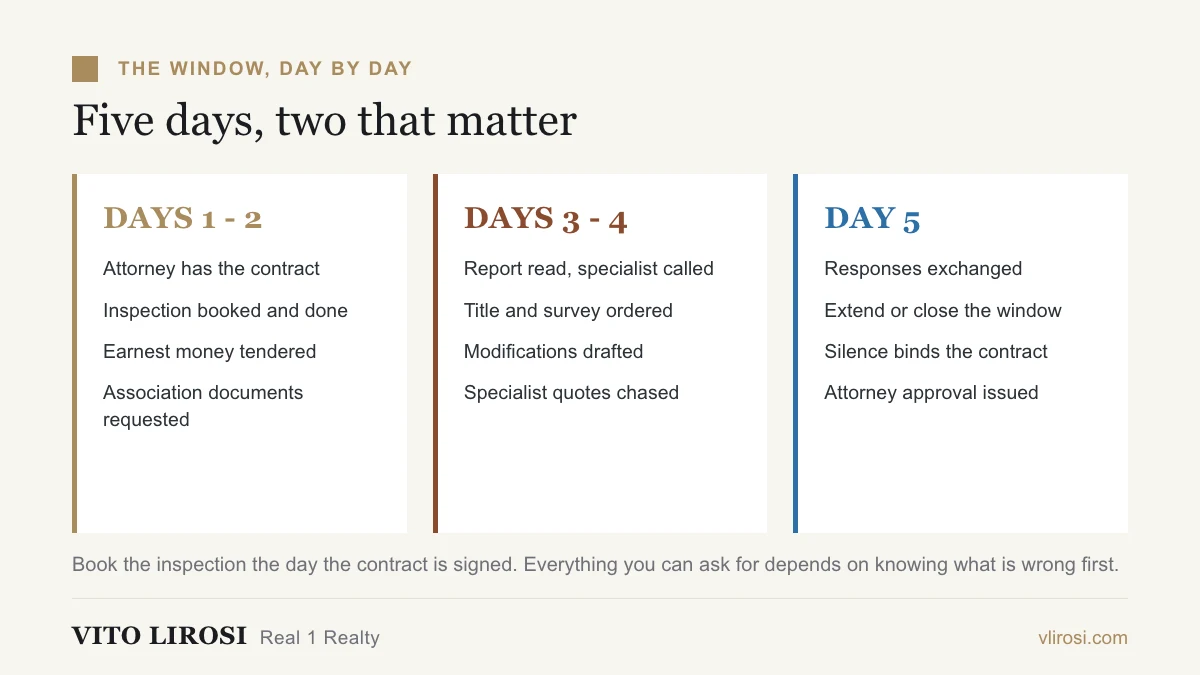
The window as a calendar. The work that wins it happens on day one and day two.
A general report will not price anything, so the specialist quote has to be chased inside the window, not after it. What the inspector should be looking for in a Northwest suburbs house is its own subject, and my home inspection checklist for buyers walks it system by system. What to do with a report once you hold it is its own subject too, and I wrote that up in my red flags when buying a house piece.
When does the window extend or close?
The period can be extended, and it is extended constantly. It takes written agreement between the parties, usually arranged attorney to attorney, and the common reasons are an inspection that could not be scheduled in time, a specialist who has not been out, or association documents that have not arrived. Ask early. An extension requested on the morning of day five, when the seller has had no signal that anything is wrong, reads very differently from one flagged on day two with a reason.
The failure mode is the opposite: nobody does anything and the window closes. Under most versions of the clause, if no notice is served within the period the contract stands as written and the chance to change it is gone. Nobody sends a reminder. This is why the date sits on my calendar for every buyer I represent, with a check-in two days before.
What to have ready before day one
- Your attorney chosen, retained, and told an offer is going out, so nobody spends day one finding representation.
- An inspector you can reach with real availability inside forty-eight hours, not the first name that answers.
- Your pre-approval current and your loan officer expecting the file.
- Earnest money ready to move on the timeline the contract names. Illinois requires every brokerage to have a written company policy, and the designated managing broker is responsible for the company's escrow accounts, so ask where your money is held and get the receipt.
- For a condo or townhome, the association documents requested the day the contract is signed. That is the item most likely to force an extension.
None of this is complicated. It is front-loaded, and the buyers who do it are the ones still holding room on day five. If you want someone who reads the house and the contract with the same eye, that is the point of working with a buyer's agent in the Northwest suburbs who inspects houses for a living. When you are ready to see what is on the market, start with my home search.
The closing statement you sign at the end also carries transfer stamp lines, and the village part changes at every town border. I explained how the state, county and village stamps work in the Northwest suburbs, including which villages charge nothing at all.
Under contract and unsure what to ask for
Send me the address and where you are in the window. I will tell you what is worth raising, what will not move, and what to get in writing before the clock runs out.
Ask Vito About Your ContractGeneral information for Northwest suburban buyers from a Realtor and licensed home inspector, not legal advice. Contract language varies and statutes change, so every question about your own contract belongs to your attorney.