Who Pays Property Taxes on a House in Probate, and the Other Bills While It Waits
An inherited house keeps sending bills while the estate waits on the court. Here is who owes each one, what happens if it slips, and how to get your money back if you covered it.
By Vito LiRosi · Realtor and licensed home inspector · September 2026
The bills an inherited house keeps sending while the estate waits.
The estate pays the carrying costs of an inherited house, through the representative. Until the estate has cash, a family member usually advances them, and the paper trail is what gets them repaid.
- The Probate Act puts it on the representative: pay the taxes, mortgages and liens on their terms, and keep the house in repair.
- Cook County bills twice: an estimated first installment at 55 percent of last year's bill, then a second installment with the rest, and missed Cook County taxes accrue 0.75 percent interest per month.
- Exemptions end with the owner. They renew automatically, which is how an estate ends up billed for one it was not entitled to.
- Keep the bill, the proof of payment and a ledger. That is what the estate's attorney needs to repay you.
The house is inherited, the estate is open, and the bills did not stop when the owner died. The tax bill still arrives, the gas company still reads the meter, and if it is a condo, the association still sends a statement every month. The first question families ask me is who pays property taxes on a house in probate, and the honest answer is short: the estate does. The longer answer is what to do when the estate has no cash yet, and how the family member who covers the gap gets paid back.
This is written for Cook County and the Northwest suburbs, where the tax calendar has its own rhythm. I am a Realtor and a licensed home inspector, not an attorney or an accountant, so anything that turns on your estate's own facts belongs to them. What follows is how it runs in practice.
The estate pays, through the representative
The Illinois Probate Act is direct about it. During administration the representative takes possession of the decedent's real estate and, while holding it, shall pay the taxes, mortgages and other liens on it in accordance with their terms. The same section says the representative shall keep the buildings in tenantable repair, may insure the property, and may make reasonable expenditures necessary to preserve it.
Two exceptions matter to families. If the will says otherwise, the will controls. And if an heir or legatee is living in the house as a residence, the representative generally does not take possession of that part unless the will provides for it or the court finds possession necessary. That second one is how a sibling living in the house ends up in a conversation about who covers what. It is a conversation for the estate's attorney, and it is better had in month one than month six.
The problem is timing. Letters of office are not issued on day one, and the estate account is usually empty until the representative can open one and move money into it. The bills do not wait. So in the common case, a family member pays out of pocket first and the estate settles up later. That is fine, if you keep the paper.
Who pays property taxes on a house in probate in Cook County?
The estate does, and the calendar does not pause for probate. Cook County bills in two installments. Under the Property Tax Code, the first installment is an estimate set at 55 percent of the prior year's total bill. The second installment carries the rest, and it is the bill where changes such as exemptions show up.
For tax year 2025, the Cook County Treasurer lists the first installment as due Wednesday, April 1, 2026, and the second installment as due Thursday, October 1, 2026. The Treasurer posts each year's installment dates on its due-dates page, so check it the week the estate opens.
Miss one and interest starts. For Cook County taxes for tax year 2023 onward, the statute sets it at 0.75 percent per month or portion of a month. Leave it long enough and the Treasurer's own site explains how to keep a property out of the annual tax sale, which is not a list any estate wants to be on.
If the owner had a mortgage with an escrow account, the servicer may be paying the taxes already. Call the servicer, tell them the owner has died, and confirm the escrow is still being funded. An escrow that runs dry because nobody made the monthly payment is a tax bill nobody paid.
What happens to the owner's tax exemptions?
This is the part that surprises estates at closing. Cook County's homeowner and senior exemptions attach to a person, not a house. The Cook County Assessor requires the owner to occupy the property as their principal residence on January 1 of the tax year. For the senior exemption, the Assessor's own guidance is that a parent who was alive and living in the home on January 1 keeps the property eligible for that year, and it explains how a son or daughter files for it.
After that year, the person who qualified is gone. The catch is that both exemptions renew automatically, so nothing stops the next bill from carrying one the property is no longer entitled to. In Cook County, 35 ILCS 200/9-275 treats that as an erroneous homestead exemption: the tax that should have been billed, plus interest and penalties, can become a lien on the house. The same section gives a taxpayer who comes forward within 60 days of receiving the assessment notice the Assessor mails in a reassessment year a way to pay the principal and interest and avoid the penalties.
I do not give tax advice, and I will not tell you what your estate owes here. What I do is ask about exemptions on day one, so your attorney or CPA has the question in front of them before a buyer's title search does it for you.
Insurance: the one bill that cannot lapse
The Probate Act lets the representative protect the real estate with insurance, and in practice this is the first call I suggest after the funeral. The policy is in the deceased owner's name, the carrier does not know the owner has died, and most homeowners policies change what they cover once a house sits unoccupied. Call the carrier, tell them who is handling the estate, and ask in writing what the policy covers while the house is empty.
The premium is an estate expense like the taxes. A lapse is worse than a late fee: a burst pipe in an uninsured house comes straight out of what the heirs inherit.
Utilities, HOA dues and the mail
Three things are cheap to keep running and expensive to let stop.
- Utilities. Heat, electric and water stay on through the winter. A house with the gas shut off in January is a house with split supply lines in February. Move the accounts into the estate's name when the representative has letters.
- Condo and association dues. Under the Condominium Property Act, unpaid common expenses, with interest, late charges and collection costs, become a lien on the unit. At resale, the seller has to provide the buyer a statement of unpaid assessments on demand, so a missed month surfaces at closing either way.
- The mail. Forward it to the representative. The tax bill, the insurance renewal and the association statement all arrive by mail, and an unopened pile in a vacant house is how a due date gets missed.
Lawn and snow belong in the same list. An uncut lawn or an unshoveled walk tells the street the house is empty, and an empty-looking house is the one that gets tried.
| Carrying cost | Who normally pays during probate | If it is missed | How it is usually handled |
|---|---|---|---|
| Property tax | The estate, through the representative | Interest in Cook County, and eventually the tax sale list | Paid by the estate, or reimbursed to whoever advanced it |
| Mortgage | The estate, under the loan's terms | Late fees, and the escrow can stop funding taxes and insurance | Kept current, then paid off from sale proceeds at closing |
| Homeowners insurance | The estate | An uninsured loss the heirs absorb | An estate expense; confirm vacancy terms with the carrier |
| Utilities | The estate, once accounts move to its name | Frozen pipes, a cold house, a restart fee | An estate expense to preserve the property |
| Condo association dues | The estate | A lien on the unit, with interest and collection costs | Shown on the resale statement and cleared at closing |
| Lawn, snow, basic upkeep | The estate | A house that looks vacant | A reasonable preservation expense, with receipts |
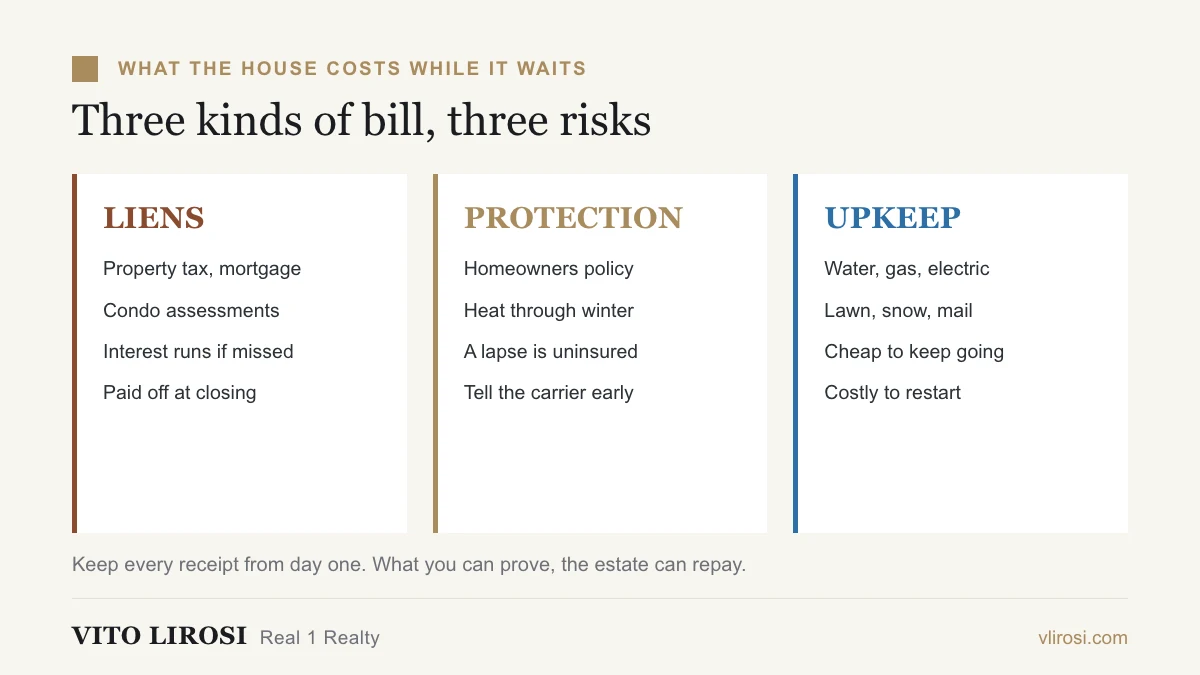
Three kinds of carrying cost, three different consequences when one slips.
The honest take
The family member who pays the tax bill out of pocket to keep the peace is doing the right thing in the wrong way. The payment helps. The missing paper trail is what causes the argument later, when the estate is splitting proceeds and nobody can prove who covered what. Pay it, then write it down.
How do you get the estate to pay you back?
The Probate Act ranks claims against an estate, and the first class includes the expenses of administration. Whether a given payment you made is treated that way is your attorney's call. Your job is to make that call easy.
- Pay from your own account, never in cash, and keep the statement that shows it.
- Keep the bill itself, not just the receipt, so the amount and the property are both on paper.
- Keep one simple ledger: date, payee, what it was for, amount, and how you paid.
- Hand the ledger to the estate's attorney before the house is listed, not after it sells.
Once the representative has letters and an estate account, the bills move into the estate's name and the out-of-pocket stage ends. From there, the carrying costs run until the house sells, which is why the listing plan matters. Every month on the market is another month of every line in that table.
If the mortgage is larger than the house is worth, or payments fell behind before the owner died, that is a different sale, and my page on selling ahead of a foreclosure explains the options. When it is time to empty the house, my guide to clearing out a house after a death covers the sequence, and the wider sale is in my guide to selling an inherited house in Illinois.
Who pays property taxes on a house in probate is the easy part: the estate. Keeping the bills paid and the paper clean while the court does its work is the hard part, and it is the part I plan with families from the first conversation. For a home in Mount Prospect there is a local page on selling an inherited home there, and across the Northwest suburbs that is what working with a probate real estate agent who plans the carrying costs with the sale is for.
Holding an inherited house right now
Send me the address and where the estate stands. I will help you list what the house costs each month while it waits, and what to line up before it goes on the market.
Ask Vito About an EstateGeneral information for families handling an Illinois estate, from a Realtor and licensed home inspector, not legal or tax advice. Statutes, rates and due dates change, and every estate is different, so confirm your specifics with your attorney and your tax professional.