Transfer Stamps in the Northwest Suburbs of Illinois: the Village Fee Nobody Budgets For
Everyone budgets for the state and county stamps. The village transfer stamp is the one that shows up late, and the paperwork behind it is what moves a closing date.
By Vito LiRosi · Realtor and licensed home inspector · September 2026
The village layer on an Illinois deed is set town by town.
Illinois stacks up to three layers of transfer tax on a deed. The state and county layers are the same across the county. The village layer is set town by town, and its paperwork is what moves closing dates.
- State: 50 cents per $500 of value, everywhere in Illinois.
- Village rates vary widely. Park Ridge charges $2.00 per $1,000, Rolling Meadows $3 per $1,000, and Palatine and Wheeling charge no village transfer tax.
- No tax does not mean no stamp. Wheeling still issues a free stamp and wants 10 business days notice.
- The final water bill comes first. Every verified town that issues a stamp wants its accounts cleared before the stamp goes on the deed.
Most sellers have heard of the transfer stamps on an Illinois deed as one line on a closing statement. There are up to three layers of them, and only one changes when you cross a town line. The village transfer stamp in the Northwest suburbs of Illinois is set town by town: some villages charge a real tax on the sale price, some charge nothing but still issue a stamp, and the ones that issue a stamp want their own accounts cleared first.
The money is rarely what hurts. The timing is. A seller who learns the week of closing that the village needs a final water reading, a paid final bill and a lead time of days is a seller whose closing slides. Here is how it works across the towns I sell in, and what to line up before the contract is signed.
How many transfer stamps are on an Illinois deed?
Up to three layers, stacked, each set by a different rule maker.
- The state comes first. Illinois imposes a tax on transferring title at 50 cents for each $500 of value, under the Property Tax Code. It is the same everywhere in the state, and the county recorder collects it when the deed is recorded.
- The county can add its own. The Illinois Department of Revenue notes that counties may impose a tax of 25 cents per $500 of value on top of the state's.
- Then the village or city. The same Department of Revenue page notes that home rule municipalities may impose an additional transfer tax of their own. This is the layer that moves.
The state and county layers are the same whichever side of a village line the house sits on. The village layer is the one worth reading about, because two houses a mile apart can carry a very different number, or none at all.
Who pays the village stamp?
Start with what the village itself says, because the village is the one issuing it. Of the towns whose rules I verified for this guide, Park Ridge is the plainest: its finance page says the seller must pay the transfer tax. Rolling Meadows says its stamps are typically paid by the seller, and that new owners of foreclosed properties may be required to pay instead.
How the cost lands on your closing statement is a separate question from who the village collects it from. That split is a contract question, and it belongs to your attorney during the attorney review period, not to a guess at the closing table. What I do is make sure the number is on the net sheet before you ever see an offer, so it is a line you planned for and not a surprise.
What does the village want before it issues the stamp?
This is the part that moves closing dates. In the verified towns below that issue a stamp, the village wants its own accounts settled before the stamp goes on the deed.
- Most start with a final water reading. Rolling Meadows asks you to call and schedule it, and says readings are typically done 48 hours before the closing date.
- The final bill has to be paid. Park Ridge issues its certificate only after the tax and all other amounts owed to the city, including the final water bill, are paid. Wheeling requires all water, sewer and garbage fees and penalties to be paid in full first.
- Some want notice. Wheeling requires the seller to give the village 10 business days notice before the scheduled closing so it can take a final meter reading and issue the stamp.
- Paperwork comes with it. Park Ridge asks for the PTAX-203 declaration, the closing date and a contact name, phone and email before it will process the tax.
Here is where my inspector's license earns its keep. The final water bill is based on a reading, and whatever the meter shows, the seller pays before the stamp issues. A running toilet, a weeping hose bib or a slow drip under a vacant house runs the meter the whole time the house is on the market. I check the meter and the obvious leak points on the first walkthrough, because a surprise on the final bill is a surprise that has to be paid before the village will issue the stamp.
Village transfer stamp rules in the Northwest suburbs, Illinois, town by town
Every row below comes from that village's own published page, checked in September 2026. A town I could not verify from its own source is not in the table.
| Town | Village transfer tax | Who pays, per the village | Before the stamp issues | Source |
|---|---|---|---|---|
| Palatine | None. The village states there is no real estate transfer tax in Palatine. | Not applicable | Not listed on the village FAQ | Village of Palatine |
| Park Ridge | $2.00 per $1,000 of value or fraction thereof | The seller | PTAX-203, closing date, contact details; all amounts owed to the city paid, including the final water bill | City of Park Ridge |
| Rolling Meadows | $3 per $1,000 of the sale price, rounded up to the next full dollar | Typically the seller; new owners of foreclosed properties may be required to pay | Scheduled final water reading, typically 48 hours before closing; final utility bill and outstanding fines and fees paid | City of Rolling Meadows |
| Wheeling | None. The village has no transfer tax and there is no fee for the stamp, but a stamp is still required. | Not applicable, the stamp itself is free | Original deed presented to the Finance Department, in person or by mail; water, sewer and garbage paid in full; 10 business days notice before closing | Village of Wheeling; Village of Wheeling, Finance FAQ |
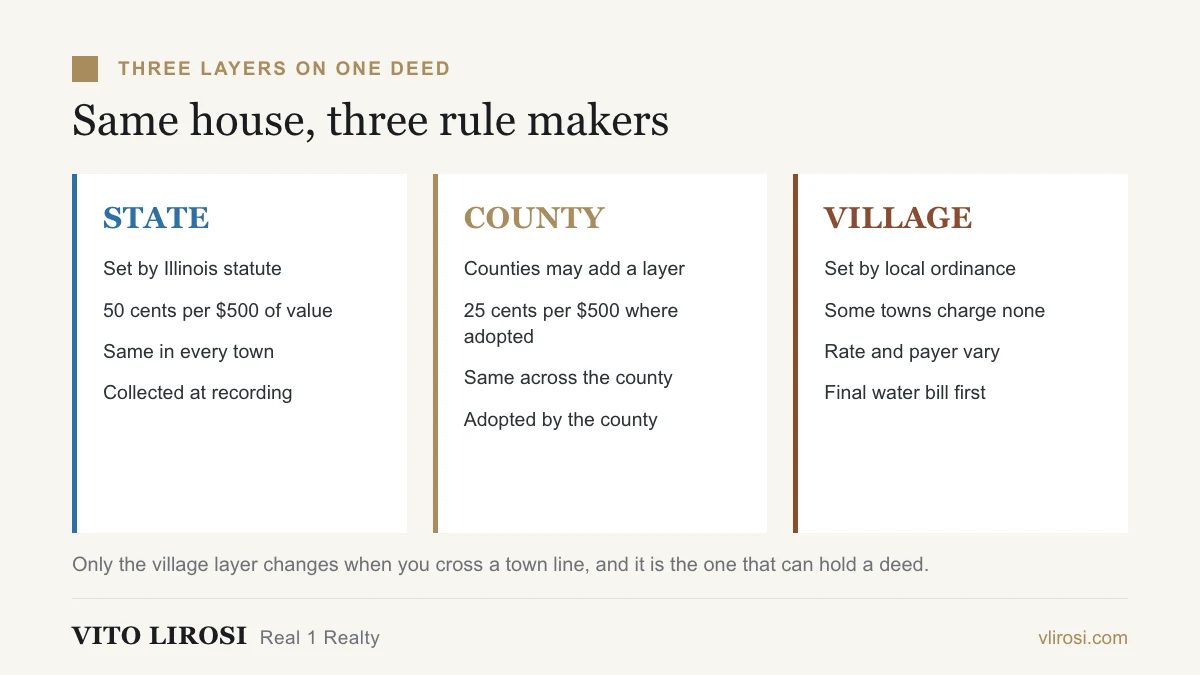
Three layers, three different rule makers. Only the village layer changes when you cross a town line.
Two things in that table surprise sellers. Wheeling charges no tax and still requires a stamp, so "no transfer tax" does not mean "no village step". And Rolling Meadows notes that some Palatine mailing addresses are subject to its stamp. The mailing address on your envelope is not always the municipality your house sits in, and the village is decided by the municipality.
For Mount Prospect, Arlington Heights, Des Plaines, Elk Grove Village and Prospect Heights, I confirm the current rule with the village finance department when a listing starts rather than print a figure here that may have changed. The questions are the same four in every town: is there a tax, who does the village collect it from, what has to be paid first, and how much notice it needs.
The honest take
The village stamp is almost never the biggest number on a seller's closing statement. It is the one most likely to be discovered last. The sellers who get squeezed by it are the ones with a buyer, a lender and an attorney all ready, and a village counter that still needs a meter reading. Call the village the week you list, not the week you close.
When to find out, and who does it
Before you list: I pull the village's current rule and put the stamp, if any, on your net sheet next to the state and county stamps. If the house is vacant, this is when I look at the meter.
Once you are under contract: your attorney confirms who carries each stamp under the contract during attorney review. My walkthrough of the five business days after an offer is accepted covers what can still change in that window.
Two weeks before closing: notice goes to the village where it is required, the final reading gets scheduled, and the final bill gets paid as soon as it posts. Wheeling's 10 business days is two calendar weeks, and it is the longest lead time in the table.
Closing week: the paid-up account clears, and the village issues the stamp. If this step is still open on the Monday of closing week, the date is already at risk.
The rest of a seller's closing costs, in one line each
- State and county stamps: the two layers above, the same across the county.
- Title charges: ordered through the title company and shown on the closing statement.
- Prorated property taxes: Illinois bills taxes a year behind, so the seller credits the buyer for time already lived in the house.
- Attorney: your own attorney's fee, agreed with them directly.
- Mortgage payoff: requested from your lender and paid from the proceeds at closing.
If you are weighing what a sale nets against a fast offer, my side-by-side of a cash offer against listing the house lays the whole closing out, and for a Mount Prospect home there is my page on selling there on a tight timeline.
The village transfer stamp in the Northwest suburbs of Illinois is small money and a big date. Know the rule for your town, clear the final water bill early, and give the village the notice it asks for. When the calendar matters as much as the price, that is what working with a Northwest suburbs listing agent who plans the whole closing, stamps included is for.
Selling in the Northwest suburbs
Send me the address. I will tell you which stamps apply to that house, what the village needs before closing, and when to start.
Ask Vito About Your SaleGeneral information for Illinois home sellers from a Realtor and licensed home inspector, not legal or tax advice. Village rules and rates change, so confirm your town's current requirements with the village and your attorney.