Earnest Money in Illinois for Buyers: How Much, Who Holds It, and How You Get It Back
The deposit is the first money you put at risk. Who holds it and what releases it decide whether you see it again.
By Vito LiRosi · Realtor and licensed home inspector · October 2026

The deposit is small next to the price. It is still the first money you can lose.
Earnest money in Illinois is a good faith deposit that counts toward your purchase price. Your offer sets the amount and your contract names the holder. A licensee holding it can release it only on written direction, contract terms or a court order.
- No Illinois statute I know of sets the amount. Your offer sets it, often in two installments.
- A licensee holding the deposit must keep it in a separate account and can release it only on the principals' written direction, the contract's terms or a court order, with an abandonment backstop after six months (225 ILCS 454/20-20).
- The deposit comes back through contingencies you exit on time, in writing. Past the deadline, it is at risk.
- A disputed deposit sits until both sides sign or a court rules. Keep a folder of every notice and receipt.
Earnest money in Illinois is the deposit a buyer hands over with an offer to show the deal is serious. It is not a down payment and it is not a fee. It is part of your purchase price, held by someone else until closing, when it is credited to you. Most of the trouble buyers get into comes from treating it as a formality, because nobody at the signing table slows down to explain who is holding it or what it takes to get it out.
I am a Realtor and a licensed home inspector, not an attorney. This is how the deposit works from where I stand when I write offers for buyers in the Northwest suburbs. Anything that turns on the wording of your contract belongs to your own attorney, and you should have one before you sign.
What is earnest money, and what is it not?
Think of it as a prepayment toward your purchase price. When you offer on a house, the contract asks you to back the promise with cash. If the deal closes, the deposit goes toward your costs at the table and you owe that much less. If the deal ends the way the contract allows, it comes back to you. If you walk away outside those allowances, the seller may be entitled to keep it. That last sentence is the whole reason the deposit exists.
It is not a fee to the agent, the seller or the title company, and nobody earns it by showing a house. Check any estimate that lists it as a closing cost. It belongs to you until a contract term or an agreement moves it to someone else. The CFPB's Owning a Home guide is a neutral place to see where it sits in the larger closing picture.
Earnest money in Illinois: how much does a buyer put down?
The amount is whatever your offer says. I know of no Illinois statute that sets a number, so there is no standard figure to quote, and anyone who gives you one is describing their own habit. What I can describe is what makes a seller read the number as serious. A deposit that looks thin next to the price tells a seller you may have an easy way out. A deposit the buyer can comfortably afford to lose tells them the buyer expects to close.
Three things move the amount in practice. The first is competition: a house with several offers gets read closely, and the deposit is one of the few terms a buyer can raise without raising the price. The second is how many protections your offer keeps. A buyer who keeps the inspection and financing contingencies can offer a larger deposit with less worry, because those exits return it. The third is your own cushion. If losing the deposit would hurt, the answer is a contract with firm exits, not a smaller deposit that fails to persuade anyone.
Plan the deposit and your cash to close together, because lenders ask where the money came from. Move it from an account you can document.
The two-installment deposit, and why it exists
Many Chicago-area contracts split the deposit into two payments: an initial amount at signing and the balance later, usually once the attorney review window has closed. Your contract names the amount and the due date of each installment, so read those lines before you sign rather than after.
The split exists because the first days of a deal are the riskiest for a buyer. With only part of the money committed, a deal that falls apart in the review window costs less to unwind. It also signals something to the seller: the first installment shows good faith, and the second shows that the buyer stayed in after the attorneys finished. The review window itself, what moves during it and how the days count, is covered in my guide to the Illinois attorney review period.
The second installment is where buyers slip. A late payment can be a default under a contract, and a default is the one thing that can turn a returnable deposit into a disputed one. Put the date in your calendar the day you sign and ask your lender or bank how long a transfer takes.
Who holds the deposit?
This is the question buyers skip, and the one that matters most. In a Northwest suburbs deal the holder is usually named in the contract: the listing brokerage, the seller's attorney or a title company acting as escrowee. Which one it is depends on the deal. The identity matters because the rules that bind the holder differ, and because getting a receipt is your only proof the money arrived.
When a licensed broker is the holder, the License Act spells out the duty. Section 20-20(a)(17) of the Real Estate License Act of 2000 makes it a disciplinary matter for a licensee to fail to keep escrow money in a special account, separate from personal and business funds. The account is non-interest bearing unless the parties require interest in writing or the law does. Mixing the money with the licensee's own is a separate ground for discipline.
Ask for three things the day the deposit goes in:
- A written receipt that names the amount, the date, the property and the person or company holding it.
- The name of the account holder, so you know whose escrow it sits in.
- A copy of the signed contract page that says who the holder is and how they release the funds.
How do you get your earnest money back?
The deposit is returned when the contract says it is, and the contract says it through contingencies. Each contingency is an exit with a deadline: an inspection period, the attorney review window, a financing commitment date, and an appraisal clause in some contracts. Used correctly, each one lets you leave and take the money with you. Used late, each one is closed, and you are then in the part of the contract where the deposit is at risk.
Two habits protect most buyers. First, put a deadline on your calendar for every contingency, counted exactly the way the contract counts it. Second, give notice in writing, in the form the contract requires, to the people it names, before the deadline and not on it. A text to your agent may not count as notice if the contract names another method. There is also a statutory exit that has nothing to do with these clauses: when a seller delivers a disclosure report showing a material defect only after everyone has signed, the buyer has five business days to terminate and recover the deposit under 765 ILCS 77/40, a clock I walk through in the attorney review guide.
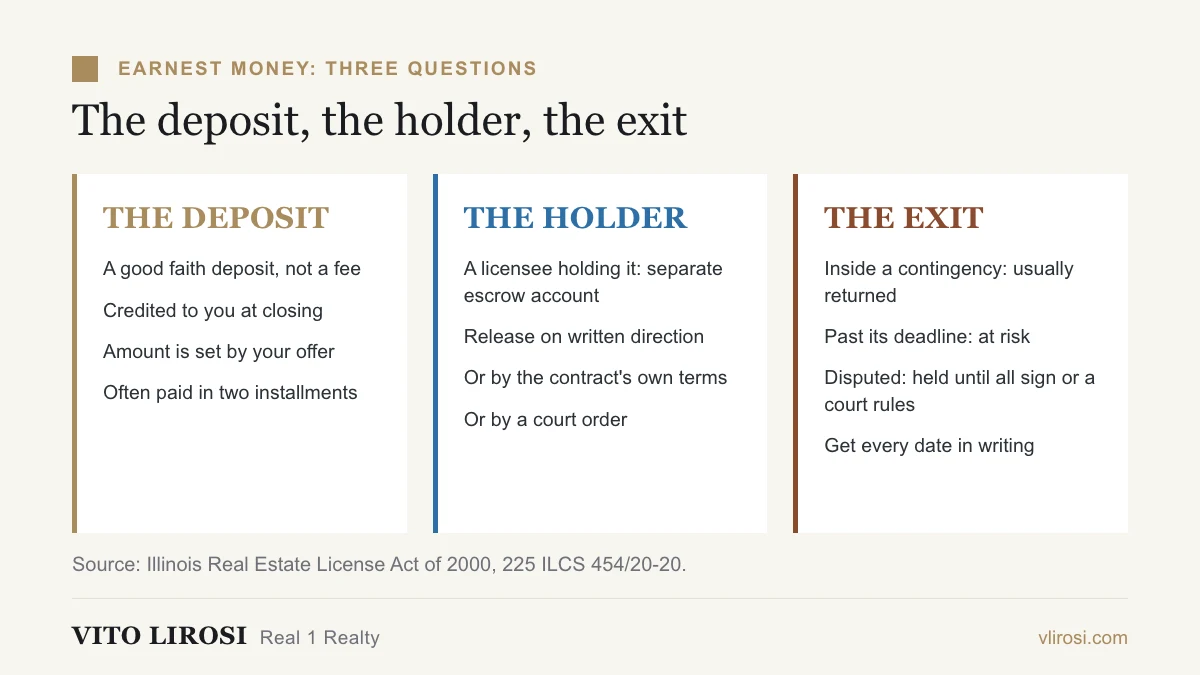
Amount and exits are in your contract. Custody and release follow the License Act.
| How the deal ends | Is the deposit normally returned? | What you do, and by when | Who has to sign for release |
|---|---|---|---|
| Inspection contingency | Yes, when you exit inside the inspection period | Written notice, in the contract's form, before the period ends | Both sides, or the contract's own release terms |
| Attorney review | Yes, under most versions of the clause when the contract ends in the window | Your attorney sends the notice inside the review period | Both sides, or the contract's own release terms |
| Financing contingency | Usually yes, if the loan is denied despite a good faith effort | Keep the lender's written denial, and give notice by the contract's date | Both sides, or the contract's own release terms |
| Appraisal clause (if your contract has one) | Depends on the wording of the clause | Read the clause with your attorney the day the appraisal arrives | Both sides, or a court order |
| Buyer walks with no contingency left | No, the seller may be entitled to keep it | Nothing protects you; talk to your attorney before you stop paying | The seller, or a court order if you disagree |
General guide to common Illinois contract structure. Your contract controls; your attorney reads it.
Entitled to the money is not the same as holding it
A buyer can be entitled to a deposit and still not have it. A holder is not a judge. A licensee cannot decide who is right and cut a check. Under section 20-20(a)(17) a licensee may release escrow money only in three ways: on the written direction of the principals, as the signed contract itself provides, or under an order of a court. A refund you are owed under the contract therefore usually needs a signed release from the seller, which is why a clean contract and a calm conversation matter more than being right.
When the deposit is disputed, and how long it sits
A dispute starts when each side claims the money and neither will sign. The holder keeps it in escrow. The License Act even bars a licensee from requiring a party who is not their client to give up part of the escrow for the licensee's own commission as a condition of release. A holder stuck in the middle can also get a binding answer from a court. Illinois lets a party facing conflicting claims bring an interpleader under 735 ILCS 5/2-409, so the court decides who gets the money.
How long all of this takes has no single answer, and I will not invent one. What I can tell you is what the statute sets. A deposit sits until the sides sign a release or a court orders it out. The one clock in the License Act applies only when no claim has been filed in court: after six months have passed since a written demand for the money by one of the principals, the licensee may treat the funds as abandoned and send them to the State Treasurer as unclaimed property. That is a backstop, not a plan. Money handed to the Treasurer can be reclaimed through the state's unclaimed property site, but you would rather never be there.
What shortens a dispute is documentation. Keep every notice you sent, the proof it was delivered, the receipt for the deposit and the signed contract. A buyer with that folder is usually in a better position to get a prompt written release than one working from memory.
Where I come in
Earnest money is part of every offer I write. I write offers for buyers across Mount Prospect, Arlington Heights, Des Plaines and the surrounding towns, and the deposit is in the first draft. If you are early in the search, my Northwest suburbs buyer's agent services start with what you can afford to put at risk and what protections the offer should keep. When you are ready to look, the search for homes in the Northwest suburbs is where it begins. And because I am also a licensed home inspector, I look at the house the way the inspection contingency will: you can read more in my inspection checklist for buyers and my guide on what to look for when buying a house.
Writing an offer and wondering about the deposit?
Tell me the house, the price range and how you plan to pay. I will walk you through what the deposit should look like and which exits to keep.
Ask Vito About Your OfferGeneral information from a Realtor and licensed home inspector with a professional background in residential appraisal. It is not legal or tax advice. Statutes are quoted as read on October 14, 2026, and how they apply to your contract is a question for your attorney.