What to Do With Everything Inside the House: Estate Sale, Donate, or Haul
The hard part of an inherited house is rarely the listing. It is the forty years of contents inside it, and the order you empty them in decides what the estate keeps.
By Vito LiRosi · Realtor and licensed home inspector · September 2026

Sorting a lifetime of contents in the order that protects the sale.
Cleaning out an inherited house is a sequencing problem, not a hauling problem. The order you do it in decides what the estate keeps and when the house can be listed.
- Search before anything moves. Illinois gives a representative 60 days after letters to file a verified inventory, and you cannot list what you already threw away.
- The contents belong to the estate, not the family. A will granting the power lets the executor sell without a court order. A will that says nothing means leave of court.
- Book the estate sale while the house is still full. Two to four weeks of lead time is normal, and that is the week most families lose.
- Donation is the last step, not the first. Good used condition or better, written acknowledgment over $250, qualified appraisal over $5,000.
Nobody plans for this part. The estate is open, the house is yours to deal with, and every closet, crawl space and garage shelf in it is still full. Most guidance on how to clean out a house after a death is written by companies that want to haul it, and it starts at the dumpster. That is the wrong end.
The cleanout is the one stage of an estate where the order of operations decides the number. Done in sequence, the contents pay for part of the work and the house is ready the week you want it listed. Done in a weekend with a roll-off out front, you pay to remove things that had buyers. What follows is the sequence I give executors in Mount Prospect, Arlington Heights and the towns around them.
Find the paper before the furniture
The first pass through the house is not a cleanout. It is a search, and the only pass where nothing leaves. You are looking for the deed, vehicle titles, the homeowners policy and its declarations page, the most recent tax bill, savings bonds, cemetery deeds, safe deposit keys, and the original will if it has not been filed.
These things are almost never in a filing cabinet. In the houses I walk they are inside books, taped behind a dresser, in a coat pocket, or in a shoebox under forty years of Christmas cards. I have had a family find the only signed copy of a will inside a photo album the week the clear-out crew was booked.
There is a second reason. Under the Illinois Probate Act a representative must file a verified inventory with the court within 60 days after their letters are issued, listing the real estate and all of the personal estate, with a supplemental inventory due within 60 days of anything found later. You cannot list what you already threw away. Photograph each room before anything moves.
What can the estate legally sell?
This is the part page one skips, and the part that gets families in trouble. The contents are not yet anyone's property to give away. They belong to the estate until the estate distributes them.
- If the will gives the executor power to sell personal property, the executor may sell without a court order, and that sale holds up even if the will is later set aside.
- If the will says nothing about it, the representative needs leave of court, granted when a sale is necessary for the proper administration of the estate.
- Anything specifically left to a named person, or that the will directs is not to be sold, stays where it is unless selling it is necessary to pay claims, administration expenses, or estate and inheritance taxes.
One route skips probate entirely and almost nobody knows it exists. Illinois allows a small estate affidavit to transfer a decedent's personal property when no letters of office are outstanding and none are contemplated, and the personal estate passing to any party is tangible and intangible personal property not exceeding $150,000, excluding vehicles registered with the Secretary of State. A houseful of furniture, tools and household goods sits well under that ceiling. If the real estate is already moving outside probate on a transfer on death instrument or in joint tenancy, the contents may need no court file at all. Ask your attorney before you open an estate you do not need.
What sells and what costs to remove
Things that reliably find buyers: hand and power tools, the contents of a well-kept garage, lawn and snow equipment that runs, solid wood furniture from the fifties and sixties, sterling and costume jewelry, fishing and hunting gear, sewing machines, a china service that is still complete, vinyl records, and anything unopened in its original packaging.
Things that cost the estate money to remove: console televisions, organs and spinet pianos, mattresses, hot tubs, particle-board bedroom sets, exercise equipment, and the paperbacks in every basement. Add paint, solvents, pesticides, pool chemicals and propane tanks, which no hauler takes in a general load because they go to a household hazardous waste collection instead.
The piano surprises families every time: the most emotionally weighted object in the house, and usually the most expensive thing to get out of it.
There are four routes out, and they differ less on price than on who carries the work and what is still sitting there on Monday. Read the last two columns first.
| Route | How the vendor is paid | Typical timeline | What is left in the house | What the estate ends up with |
|---|---|---|---|---|
| Estate sale in the home | A share of gross sales, often with a stated minimum | Two to four weeks to research, price and stage, then a weekend | Whatever did not sell, unless the contract says otherwise | The best return on a broad, mid-range houseful |
| Auction, online or on site | A seller premium on the hammer price, plus removal | Longer, cataloging and photography add weeks | Nothing, everything goes to the auction house | Strong on a few good pieces, thin on ordinary contents |
| Donation pickup | Free, and you receive no proceeds | Days once scheduled, but pickups book out | Everything they decline, which is more than families expect | A receipt, and a deduction only if it qualifies |
| Haul-away clear-out | By volume or by truckload | One or two days | Nothing, the house is left broom clean | Speed, and no recovery on anything |
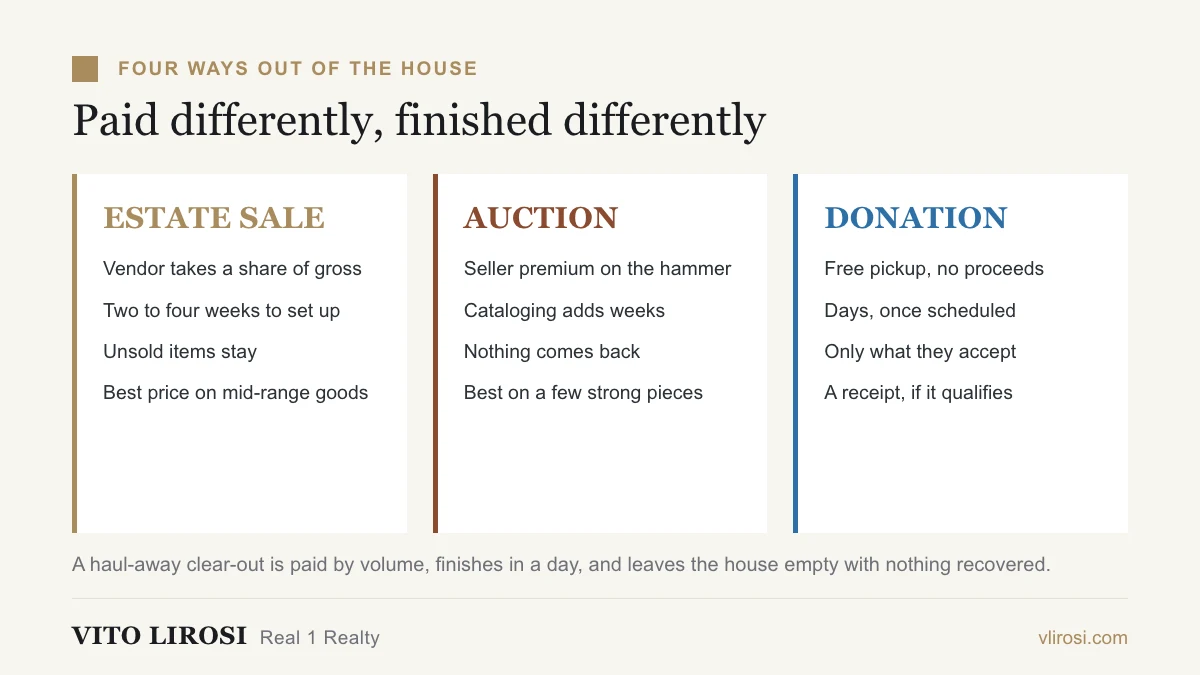
Four routes out of the house. Each one is paid differently and leaves a different amount behind.
Three questions decide an estate sale contract before you sign it. Who pays to remove what does not sell. Whether there is a minimum, and what happens if the sale misses it. Whether the company can walk after the walkthrough. A company that will not put the leftover-removal answer in writing has told you the answer.
What makes a donation count?
Families donate the bulk of a house and assume the deduction takes care of itself. It does not. The IRS rules turn on three figures.
At $250 a receipt is no longer enough on its own. You need a contemporaneous written acknowledgment from the charity naming the organization, describing the property, and stating whether anything was given in return. Above $500 for a noncash contribution, Form 8283 goes with the return. Above $5,000 for an item or a group of similar items, you need a qualified appraisal, and the appraiser signs Section B of Form 8283.
Underneath it sits a condition test. Household goods and clothing are not deductible unless they are in good used condition or better, and the exception runs backwards from what people expect: something below that standard can still be claimed if you claim more than $500 for it and get the qualified appraisal. The worn clothing going to a donation bin is a kindness, not a deduction.
The honest take
Most families clean out in the wrong order because grief makes the contents feel urgent and the paperwork feel cold. It is the reverse. The contents will wait. The deed, the policy and the tax bill will not, and the moment a crew starts carrying boxes out you have lost the ability to find them. Sit in the house for one afternoon with a notepad before anyone books a truck.
How to clean out a house after a death, in the order that protects your listing date
While the estate waits on authority: search for the paper, photograph every room, secure the house, confirm the insurance covers a vacant property, and keep the utilities on in the estate's name. Sell nothing, donate nothing, haul nothing. Get a walkthrough from an estate sale company and a hauler now, and tell them you are waiting on letters.
Keeping the insurance and utilities on is only part of what the estate owes in that stretch. The property tax installments and any condo dues keep running too, and the bills a probate house still has to pay are listed one by one, with who normally covers each.
The week authority comes through: book the estate sale. Two to four weeks of lead time is normal, and that clock runs while everything else waits.
After the sale weekend: donation pickup for what qualifies, then the haul-away, then the cleaning crew and any paint or carpet. Trades cannot work around furniture.
The week before photos: empty, clean and lit. The week that gets lost is always the same one: the family waits until the house is empty to call an estate sale company, then waits three more weeks for a slot. Call while the house is still full, because a full house is what they are pricing.
Whether to clean out and list, repair, or renovate is a separate call, and I walk through it in my guide to selling an inherited house in Illinois.
What an emptying house still needs
Heat stays on through the winter, no lower than the mid fifties, or you will be replacing supply lines instead of listing. Check the sump pump runs and has power. Tell your carrier the house is vacant, because most homeowners policies restrict coverage once a property is unoccupied past a stated number of days. Then walk every room, closet and crawl space yourself before the last truck leaves. Crews clear what they are told to clear. They do not open the attic hatch.
Knowing how to clean out a house after a death is mostly knowing the order. Once the house is empty and the paperwork is intact, the sale is an ordinary sale with an extraordinary amount of feeling attached. If you want that stage handled by someone who has sequenced it before, that is the point of working with a probate real estate agent who coordinates the cleanout and the sale together. For Arlington Heights I keep a dedicated page on selling an inherited home there, and when a parent is moving out rather than one who has passed, the decisions are theirs, which is what changes when a parent is moving out rather than one who has passed.
Not sure what order to do this in
Send me the address and where the estate stands. I will tell you what has to happen before anything leaves the house, and roughly what the contents are worth keeping for.
Ask Vito About an EstateGeneral information for families handling an Illinois estate, not legal or tax advice. Statutes change and every estate is different, so confirm your specifics with your attorney and your tax professional.