Probate Real Estate Agent in Arlington Heights: Sell an Inherited Home With Someone Who Reads the Whole House
If you are looking for a probate real estate agent in Arlington Heights, IL, you are most likely holding a set of keys, a court file and a list of things nobody has explained yet. I am a licensed Realtor, a currently licensed home inspector and a former residential appraiser, and I work with families selling an inherited Arlington Heights home from the first walk-through to the closing table.
- Licensed Realtor
- Licensed Home Inspector
- Former Appraiser
Name, email and phone. I will call you back myself, and the first visit to the house costs you nothing and commits you to nothing.
Confidential and no pressure.
When an Arlington Heights family needs a probate agent, not just a listing agent
The house has not been on the market in decades, the person who knew its history is gone, and the people deciding what happens next are often not in the same state. Four situations come up again and again here:
- The executor lives out of state and can get here for a weekend, maybe two, before something has to be decided.
- Siblings disagree on what the house is worth and how much work it needs, with no neutral read to point at.
- The home has been in one family for forty years. Original furnace, original service panel, a roof with one more winter in it if you are lucky.
- The court sets part of the timeline and no one in the family has seen that process before.
The legal side belongs to your estate attorney, and the Illinois-level questions are answered on my probate and estate sales page. What I handle is the house itself and the sale around it, which is the part that tends to get guessed at.
How to judge an agent before you hand over an estate home
Most agents will say they have handled probate. Ask better questions than that before you sign anything:
- Have they sold an estate home in Cook County before, and can they say what slowed it down?
- Can they read condition themselves, or do they find out what is wrong when the buyer's inspector says so?
- Do they understand how a home is valued, not just what the last three sales on the block closed at?
- Will they work directly with your estate attorney instead of leaving you to relay messages?
- Do they say plainly where the line is between real estate advice and legal or tax advice?
- Will they come look at the house before quoting you anything?
What I will not promise you
No promised sale date. The court and the letters of office set part of the clock and I control neither. Anyone giving you a closing date before the estate is open is selling you a feeling.
No legal or tax advice, ever. Authority to sell, court approval, creditor claims, capital gains: those go to your estate attorney or your accountant, and I will say so every time they come up.
No push toward a quick cash offer. Sometimes a cash sale is the right answer for an estate, and when it is I will say so. Both sides of that decision are written out on my cash offer versus listing page.
And no number over the phone before I have stood in the house.
What the work looks like, from the first walk-through to the closing table
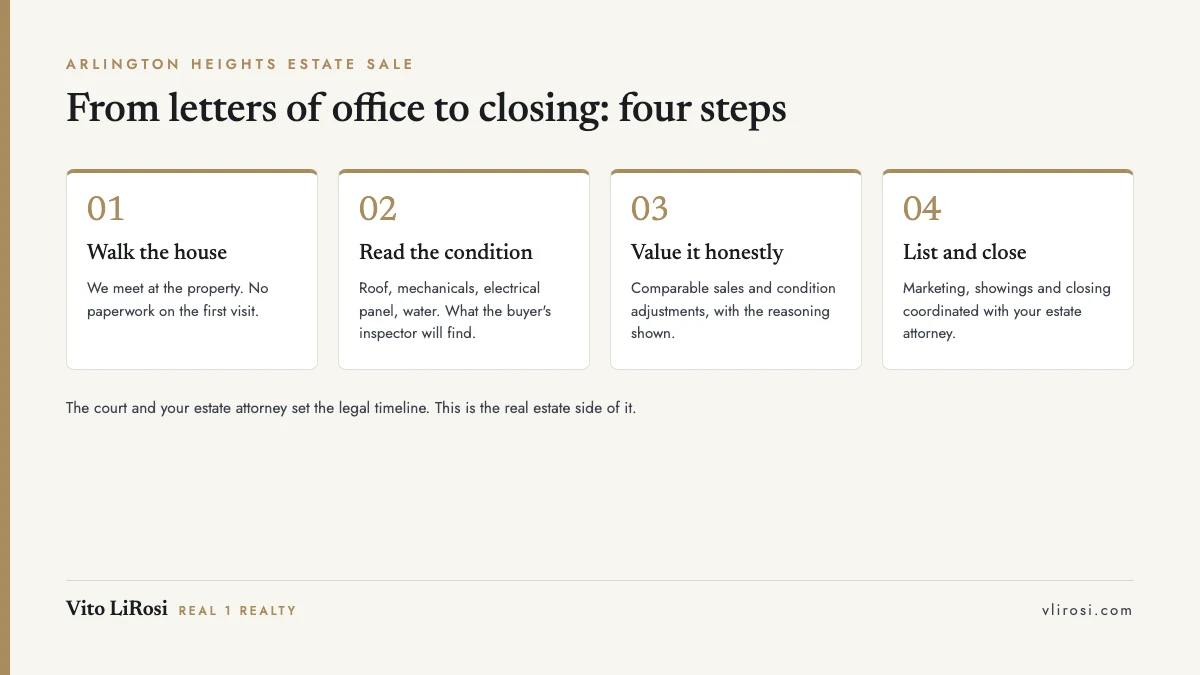
Here is the whole thing, start to finish, so there are no surprises.
- We meet at the house. You, whoever else needs to be there, and me. No paperwork on that first visit.
- I walk it as an inspector: roof, mechanicals, electrical service, water in the basement. The findings a buyer’s inspector will use to re-trade the price in six weeks.
- I value it the way I was trained to as an appraiser and show you the reasoning. If the court or your attorney needs a formal appraisal, I will tell you that too.
- We decide what gets touched. Often a clean-out and nothing else. That call is easier once someone has priced both versions of the house.
- We list it, market it properly, and I schedule showings around whatever the family is dealing with.
- I work with your estate attorney through contract, inspection and closing. Those legal steps are explained on the probate hub.
Step four is the one families underestimate. What may be sold, what still has resale value, how each vendor is paid and what the house needs while it empties are set out in the clear-out guide for estate homes.
What is different about selling an estate home in Arlington Heights
Most of Arlington Heights sits in Cook County, though part of the village extends into Lake County, and that decides where the estate is filed. Cook County estates generally go to the Probate Division at the Richard J. Daley Center in Chicago; a Lake County estate does not. Your attorney confirms the county and the district, not me, and the probate hub covers where Northwest-suburbs estates get filed. Three local things shape almost every estate sale in town.
The housing stock is a specific vintage. 36.3 percent of village housing units were built between 1940 and 1969 and another 40.5 percent between 1970 and 1989, with a median year built of 1974 (CMAP Community Data Snapshot, June 2026). Most estate homes I see here are original-owner ranches and split-levels with mechanicals at or past their service life. That is the biggest single driver of what a buyer will pay, and it is the part I read before the market does.
Permit history matters more than families expect. A finished basement, a bathroom addition or a garage rebuild may or may not have been permitted. The Village of Arlington Heights runs an online permit and property portal; check it before the listing goes up, not during attorney review.
Exemptions do not transfer. Cook County property tax exemptions attached to the person who lived there generally end with that owner. What that means for this estate is a question for your attorney or CPA, and it should not be a surprise at closing.
The tax bill itself keeps arriving while the estate is open, and so do the insurance premium and the utilities. What the estate pays while the house waits walks through each carrying cost, the Cook County due dates, and how the estate repays anyone who advanced one.
If the family’s priority is speed rather than the last dollar, that is a different conversation, written out on selling a house fast in Arlington Heights.
Who you are working with: Vito LiRosi, Real 1 Realty
I am a licensed REALTOR® and a licensed home inspector, and I worked as a residential real estate appraiser before that. On an estate home that combination is the whole point: what is wrong with the house, what it is worth as it sits, and what changes if you spend money on it, without hiring three people to find out.
Every buyer who walks through your parents’ house will have a home inspector in their corner. On an estate sale, where nobody living has the full history of the property, having one in yours matters more than usual. More background is on the about page, and the guide for families in this exact spot is how to sell an inherited house in Illinois.
Questions from Arlington Heights families settling an estate
I inherited a house in Arlington Heights and I live out of state. What is the first step?
Get the estate opened with an attorney, then send me the address. I can walk the house without you and send photos plus a written read on condition, so you know whether a trip is worth booking. Most out-of-state executors I work with make one trip, not four.
What do you check at an Arlington Heights estate home before we list it?
The same things a buyer’s inspector will: roof and flashing, the age of the furnace and water heater, the electrical panel, water in the basement, grading, windows, and work that looks unpermitted. On a house of this vintage those findings move the price more than paint color does.
How do you price an Arlington Heights home that has not been updated since the 1970s?
Against what buyers pay for that condition today, not against the updated house down the street. I show you the comparable sales and the adjustments for condition and mechanicals. A formal appraisal for the court file is a separate engagement and I will point you to it.
Can we meet at the house before anything is decided?
Yes, and I prefer it. The first visit is a walk-through and a conversation, no listing agreement. Families usually leave it knowing what the house needs, which is the thing that had everyone stuck.
Who coordinates with the estate attorney during an Arlington Heights sale?
I do, with your permission. Your attorney handles the court side and the legal documents. I handle the listing, the buyer, the inspection response and closing logistics, and keep your attorney copied so nothing waits on a message that never got relayed.
Settling an estate in Arlington Heights? Start at the house.
One walk-through tells you what the home needs, what it is worth as it sits, and what the sale is going to look like. No listing agreement required.
Related pages: Probate and estate sales in Illinois · Sell my house fast in Arlington Heights · Cash offer or listing: an honest comparison · How to sell an inherited house in Illinois · Senior downsizing · About Vito LiRosi · Talk to Vito
Neutral references: Illinois Probate Act of 1975 (755 ILCS 5) · Cook County Clerk of the Circuit Court, Probate Division · Cook County Assessor · IRS Publication 559 · Village of Arlington Heights