Cook County vs Lake County Property Taxes: Why Two Similar Houses Get Very Different Bills
Two houses fifteen minutes apart, similar size, similar age, and two very different tax bills. The county line is part of the answer. It is not the biggest part.
By Vito LiRosi · Realtor and licensed home inspector · September 2026
Same house, different county, different math.
Cook County writes a house down at 10 percent of market value and multiplies it by a state factor; Lake County writes it down at one third. By the time the rate is applied they are measuring the same thing. The rate, set mostly by school districts, is what moves your bill.
- Cook: 10% assessment, 3.0355 equalizer (2024), reassessed every 3 years. The north suburbs were reassessed in 2025.
- Lake: one-third assessment by township assessors, reassessed every 4 years. 2023 was the last general assessment year; 2027 is next.
- Cook's north and northwest suburbs median residential bill was $7,503 for tax year 2024 per the County Treasurer. No Lake County median is printed here; the address-level bill is the number to use.
- Check the address, not the county. Pull the bill, strip the exemptions you will not carry, read the taxing districts.
Picture two houses a buyer is choosing between. Both brick, about the same age, fifteen minutes apart. One is in Cook County and one is over the line in Lake, and the tax bills are far enough apart to raise the question I get every spring: Cook County vs Lake County property taxes, is one county just more expensive? The honest answer is that the county line explains how the bill is measured, and the school district explains most of what it costs.
I spent years in residential appraisal before I sold houses, so assessed value is a number I have read many thousands of times. I am a Realtor and a licensed home inspector, not an assessor or a tax attorney; anything that turns on your own bill belongs to them. What follows is how the two systems work, where they differ, and how to check any address before you write an offer.
How is an Illinois tax bill built?
Every Illinois bill runs through the same four steps, and the county only controls the first two. First the assessor puts a value on the house. Second the state applies an equalization factor so that every county's values sit at the same fraction of market value. Third, exemptions come off. Fourth, the tax rate set by the taxing districts the house sits in, school districts above all, is applied to what is left.
The statute sets the target for that second step. Under 35 ILCS 200/9-145, property outside the large classifying counties is valued at 33 1/3 percent of its fair cash value, and under 35 ILCS 200/17-5 the Illinois Department of Revenue equalizes each county so its total assessed value lands at that same one third. That is why a Cook County bill and a Lake County bill can start from very different assessed values and still be comparable by the time the rate is applied.
Cook County vs Lake County property taxes: where they genuinely differ
Three places: how much of the market value the assessor writes down, who does the assessing, and how often the whole county gets revalued.
Cook County classifies property. The Cook County Assessor's own page on assessment notices and tax bills puts it plainly: for residential property the assessed value equals 10 percent of the fair market value of the home. The state equalizer then multiplies that figure up. The Cook County Clerk publishes the factor each year; its historical equalization factor table lists 3.0355 for tax year 2024 and 3.0300 for tax year 2025. So a Cook house is written down at a tenth of its value and multiplied by about three, which lands close to the one third that Lake County starts from.
Lake County does not classify. Its township assessors value a house at the statutory one third, and the county's supervisor of assessments equalizes the townships before the state applies its own factor. The house is valued by the township the house sits in, which is why two Lake County addresses in different townships can be treated a little differently even before the rate is applied.
The calendar is the third difference. The Cook County Assessor's assessment calendar describes a triennial cycle: one third of the county is reassessed each year, with the south and west suburbs up in 2026 and the north suburbs, which includes the Northwest suburbs, reassessed in 2025 for the bills that arrive in 2026. That schedule comes from 35 ILCS 200/9-220. Lake County runs on the four-year cycle in 35 ILCS 200/9-215: general assessment years of 1995 and every fourth year after it, which makes 2023 the last one and 2027 the next.
What that means for a buyer: in a Cook County reassessment year, the whole region moves at once and the bill can jump; in the two years between, changes are smaller. In Lake County the same thing happens on a four-year rhythm. A house bought the year before its county reassesses carries a bill that is about to be recalculated.
The numbers a primary source will stand behind
Every page on this subject says the counties are different and then declines to print a figure. Here is what public record supports, with the year attached, and where it does not, the table says so rather than guessing.
The Cook County Treasurer's 2024 Tax Year Bill Analysis, published November 2025, reports the median residential tax bill in the north and northwest suburbs of Cook County at $7,503 for tax year 2024, up 3.4 percent, and $6,258 in the south and southwest suburbs. It also records the 2022 reassessment of the north and northwest suburbs, when the median homeowner bill there rose 15.7 percent to $7,008. Those are medians across hundreds of thousands of homes, so your bill on a specific street will sit above or below them.
For Lake County I do not print a median, because the only countywide figures in circulation come from third-party calculators, and that is not a source I will put my name under. What Lake County does publish for any address is the full bill history, through its property tax information search. For the houses my buyers are choosing between, that address-level record is the number that matters anyway.
| Item | Cook County | Lake County | Source |
|---|---|---|---|
| Residential assessment level | 10% of market value | 33 1/3% of market value | Cook County Assessor; 35 ILCS 200/9-145 |
| State equalization factor | 3.0355 (tax year 2024), 3.0300 (2025) | Set annually by the Department of Revenue for Lake County | Cook County Clerk; 35 ILCS 200/17-5 |
| Who assesses | The Cook County Assessor | Township assessors, equalized by the county | Cook County Assessor; 35 ILCS 200/9-210 |
| Reassessment cycle | Every 3 years; north suburbs 2025, south and west 2026 | Every 4 years; 2023, then 2027 | 35 ILCS 200/9-220; 35 ILCS 200/9-215 |
| Median residential bill | $7,503, north and northwest suburbs, tax year 2024 | Not printed: no Lake County primary source cited | Cook County Treasurer, 2024 Tax Year Bill Analysis |
| Look up an address | Assessor address search; Treasurer bill search | Lake County property tax information search | Linked below |
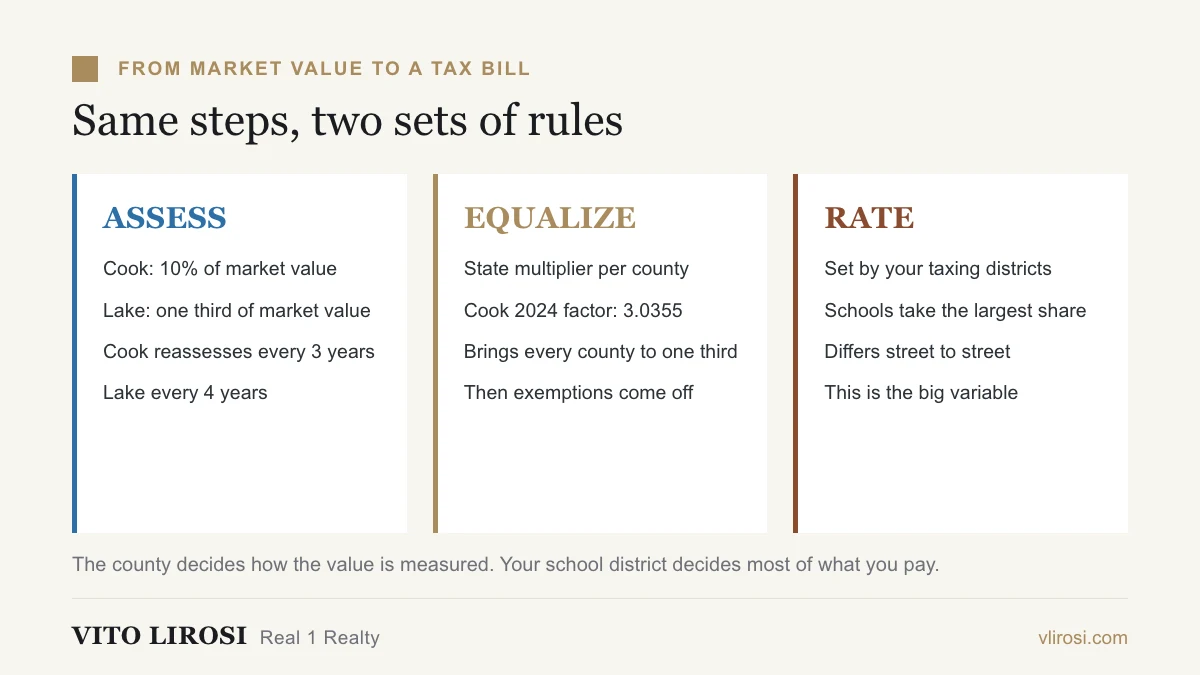
Four steps from market value to a bill. The county changes the first two; the taxing districts set the last.
What moves your bill more than the county does?
The tax rate, and the rate is not a county number. It is the sum of every taxing district the house sits in: the school districts first, then the village, the park district, the library, the township, the county, the forest preserve and whatever else has a line on the bill. Two houses on the same street in the same county can have different rates if a school district boundary runs between them. That is usually the variable two houses like these are really separated by, and it is invisible until you read the bill.
Exemptions are the other lever, and they belong to the owner, not the house. The Cook County Assessor's homeowner exemption requires the owner to occupy the home as a principal residence on January 1 of the tax year, and the senior exemption adds to it for owners who qualify. The general homestead exemption itself is statewide, under 35 ILCS 200/15-175, so Lake County owners have it too. The trap for a buyer is reading a listing's tax figure that carries a senior exemption you will not have. The seller's bill is the seller's bill. Yours is recalculated with your exemptions and, after the next reassessment, your purchase price in the record.
The honest take
"Which county has lower taxes" is the wrong question, because you do not buy a county. You buy an address inside a school district, a village and a township, and each one sets a piece of the rate. Pull the actual bill for the actual house, strip out exemptions you will not carry, and compare those two numbers. Everything else is a headline.
How to check any address before you write an offer
This takes ten minutes and I do it on every house a buyer is serious about.
- Pull the current bill. Cook County: the Assessor's address search for the assessed value and exemptions, and the Treasurer's site for the bill and payment history. Lake County: the property tax information search linked above, which shows the bill, the taxing districts and the history.
- Read the exemptions on it. Note every one the current owner has that you will not.
- Read the taxing districts. The school district lines tell you why this house's rate is what it is.
- Check where the house sits in its county's cycle. A Cook house in the north suburbs was just reassessed for 2026 bills; a Lake house is two years from its next general assessment.
- Compare the two houses on the recalculated number, not the listing figure. Then decide.
What happens to the bill the year after you buy, when the sale price enters the record and the exemptions reset, is its own subject and I will cover it separately. For where the two houses sit in the wider market, my guide to the best Chicago suburbs, corridor by corridor compares the areas, and my home search page is where the listings live.
Cook County vs Lake County property taxes is a real difference in how a house is measured and how often, and a much smaller difference in what you end up paying than the school district line running past the driveway. If you are moving into the Northwest suburbs and choosing between towns on either side of the county line, that comparison is part of what working with a relocation realtor who knows the Northwest suburbs town by town is for, and it is the same conversation I have with every buyer I represent before an offer goes in.
A village that sits mostly in Cook County with a small part in DuPage is a good example of why the county has to be confirmed by address, and moving to Elk Grove Village walks through that check for a buyer there.
Choosing between two towns on either side of the county line
Send me the two addresses. I will pull both bills, strip out the exemptions you will not carry, and show you the comparison that matters before you write an offer.
Ask Vito About a HouseGeneral information for buyers in the Northwest suburbs of Chicago, from a Realtor and licensed home inspector with a background in residential appraisal, not tax or legal advice. Assessment rules, factors and figures change by year; confirm your own bill with the county and your attorney or CPA.