Moving to Elk Grove Village: The Houses, the Blocks, and What an Inspector Checks First
Most of the houses here went up in the same few decades, which makes them easier to compare and easier to inspect, once you know what that era tends to hide.
By Vito LiRosi · Realtor and licensed home inspector · October 2026
One village, a few decades of houses, and a short list of things to check.
Most of Elk Grove Village was built in a few decades, so the houses are easy to compare. The median home was built in 1974, which tells you what to check before you make an offer.
- Housing: 58.7% single-family detached, 47.9% built 1970 to 1989, median year 1974 (CMAP, June 2026).
- Check branch wiring on houses built 1965 to the mid-1970s, plus furnace age, roof layers and drainage.
- Townhomes and condos: read the association budget, reserves and rules before you commit.
- Confirm the county (Cook or DuPage), the school district and the village's closing requirements by address.
People moving to Elk Grove Village usually have it on a short list for practical reasons: the drive to O'Hare, the expressways, the size of the lots, a job in the area. What they rarely know going in is how alike the houses are, and why that is useful to a buyer. This guide covers what the housing looks like, what a house of that age tends to need, and the local items worth settling before you write an offer.
I am a Realtor and a licensed home inspector, and I worked in residential appraisal before either. What follows is the short version of what I look at when a buyer asks me about a house in this village.
What is the housing in Elk Grove Village like?
Elk Grove Village built out quickly, and the numbers show it. According to the CMAP Community Data Snapshot for Elk Grove Village (June 2026, American Community Survey 2020 to 2024), 47.9 percent of the village's housing units were built between 1970 and 1989 and another 36.8 percent between 1940 and 1969. Only 1.8 percent went up in 2010 or later. The median year built is 1974.
Most of it is houses rather than apartments. Single-family detached homes are 58.7 percent of the housing and townhomes another 11.9 percent, and close to three in four homes are owner-occupied. Three- and four-bedroom homes make up more than half the stock.
| Housing measure | Elk Grove Village | Cook County |
|---|---|---|
| Single-family detached | 58.7% | 39.6% |
| Built 1970 to 1989 | 47.9% | 19.7% |
| Median year built | 1974 | 1961 |
| Owner-occupied | 74.7% | 57.7% |
| Three or more bedrooms | 62.2% | 48.5% |
| Mean commute, minutes | 25.5 | 31.5 |
Source: CMAP Community Data Snapshot, Elk Grove Village, June 2026 (American Community Survey 2020 to 2024).
For a buyer that sameness is an advantage. When most of the houses on a street were built within a few years of each other, the comparison between two of them comes down to condition and updates rather than style. That makes it easier to see which house is the better buy, as long as you know what to look at.
What should you check on a 1970s Elk Grove Village house?
This is the era most of the village was built in, so it is the list most buyers here need. None of it is a reason to pass on a house. It is what separates a fair offer from an expensive surprise.
The branch wiring. The U.S. Consumer Product Safety Commission's publication on aluminum wiring says homes built before 1965 are unlikely to have aluminum branch circuit wiring, and that cable installed between 1965 and the mid-1970s may contain it. A lot of this village falls in that window. It can be made safe with the right repair, but you want to know before you make an offer, not after.
The furnace and water heater. A house from 1974 is usually on its second or third furnace. The manufacture date is on the data plate inside the unit, and it is a better guide than anyone's memory of when it was replaced.
The roof. Ask how old it is and how many layers are on it. A second layer over the original was common, and a roof with two layers costs more to replace.
Water around the foundation. Look for downspouts that empty right at the wall, soil that slopes toward the house, and staining in the basement or crawl space. Ask whether there is a sump pump and how often it runs.
Additions and finished basements. Houses this age have often been expanded. Ask whether the work was permitted. The Illinois Residential Real Property Disclosure Act requires sellers to disclose certain known material defects, and the disclosure form is the place to start, but it is not an inspection.
Two more items belong on the list for a house this age. The first is the sewer line. On a house from the 1970s the line out to the street may still be the original pipe, and tree roots and shifted joints are the usual trouble. A sewer camera inspection is a small cost next to digging up the yard, and it fits inside the inspection period. Ask the seller whether the line has ever been rodded or replaced, and ask the village which part of the line the owner maintains.
The second is the windows and the sliding door. Original windows from this era often have failed seals, which shows up as fog between the panes, and patio sliders wear at the track. Neither is a reason to walk away, but a house with every original window has a replacement project coming, and that belongs in the price you offer.
My general walkthrough for any house is in what to look for when buying a house, and the system-by-system list is in the home inspection checklist for buyers.
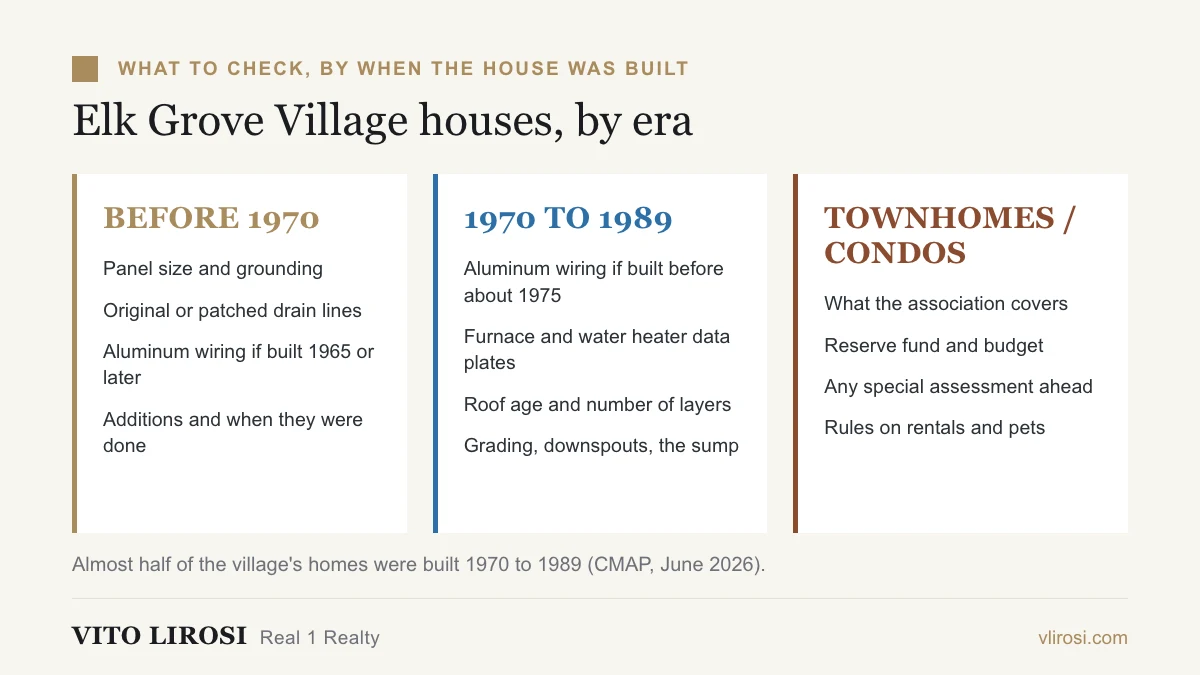
Three kinds of house, three different short lists. Most of the village falls in the middle column.
Townhomes and condos: read the association first
About 12 percent of the village's housing is townhomes and roughly 16 percent is in buildings of 20 units or more, per the same CMAP snapshot. With either, a big part of what you are buying is the association. Before you commit, get the budget, the reserve figures, the most recent meeting minutes and the rules. Ask directly whether a special assessment is planned, and find out which parts of the building are yours to maintain and which belong to the association. Roofs, windows and decks are where those lines tend to differ from one complex to the next.
Which county is the house in?
Most of Elk Grove Village is in Cook County, but a small part of it is in DuPage County. The county decides who sends the tax bill, how the property is assessed and where the deed gets recorded, so confirm it from the listing or the tax bill before you compare two houses on taxes. How Cook County assesses a house, and why the school district matters more than the county line, is covered in Cook County vs Lake County property taxes.
Closing costs have a local piece too. The village may have its own transfer stamp and pre-sale requirements on top of the state transfer tax, and those rules change. How they work across the area is in my guide to village transfer stamps in the Northwest suburbs.
Getting around, schools and the airport
This is a driving village. The CMAP snapshot shows 73 percent of workers drive alone and the mean commute is 25.5 minutes, shorter than the Cook County average of 31.5. About 16 percent work from home.
Schools are assigned by address, and more than one district serves the village, so check the exact address with the district before you rely on a listing description. Two of the districts that serve parts of the village are Community Consolidated School District 59 and Township High School District 214.
The east side of the village borders O'Hare. Some buyers do not mind it at all and some do. If you are weighing a house near the airport, visit at a few different times of day, and look up the address on the City of Chicago's O'Hare noise information page before you decide.
Is radon worth testing for in Elk Grove Village?
Yes, and it applies to the whole region, not just this village. The Illinois Emergency Management Agency's radon program explains testing and lists licensed radon professionals in Illinois. A radon test can run during your inspection period, and if the level is high, mitigation is a known, fixable item to negotiate rather than a reason to walk away.
How I help buyers moving to Elk Grove Village
I walk the house with you the way an inspector would before you make an offer, so the price you offer reflects what the house will need. Then your own inspection confirms it rather than surprising you. If you are still deciding between this village and its neighbors, my guide to relocating to the Northwest suburbs of Chicago compares the towns side by side, and working with a buyer's agent who is also a home inspector explains how that works from the first showing to the closing table.
If you are selling a house in the village before you buy, the plan for that is on my sell my house fast in Elk Grove Village page.
Looking at a house in Elk Grove Village?
Send me the address. I will tell you what the house likely needs for its age, what to ask the seller, and what to look at on the first showing.
Ask Vito About a HouseGeneral information for buyers from a Realtor and licensed home inspector with a background in residential appraisal. It is not legal, tax or engineering advice, and village and county requirements change; confirm anything specific to a property with the village, the county and your attorney.