Dying Without a Will in Illinois: What Happens to the House, and Who Can Sell It
The statute decides who inherits. It does not hand anyone the authority to sell, and that gap is where families get stuck.
By Vito LiRosi · Realtor and licensed home inspector · October 2026
Who inherits is one question. Who can sign is a different one.
When an Illinois resident dies without a will, the Probate Act says who inherits the house and in what shares. Nobody can list or sell it until the court appoints an administrator and issues letters of office.
- Spouse and children split the estate half and half; children alone take all of it; a spouse alone takes all of it (755 ILCS 5/2-1).
- The surviving spouse has first preference to be appointed, then the children. The appointment is what makes a signature mean something.
- A small estate affidavit moves personal property only. A house needs a probate case, unless the deed already passes it outside probate.
- While the estate is open the administrator holds the house, except any part an heir lives in, keeps it repaired and the taxes paid, can insure it, and decides when it lists.
Dying without a will in Illinois leaves a house stuck for a while, and the reason surprises most families. The Probate Act answers the question everyone asks first, which is who inherits. It answers it in fractions. What it does not do is hand any of those heirs the right to sign a listing agreement, accept an offer or convey a deed. That authority comes from the court, through an appointed administrator, and until it exists the house cannot be sold by anyone.
I am a Realtor and a licensed home inspector, not an attorney. What follows is the part of an intestate estate I see from the driveway: who ends up owning the house, who is allowed to sign for it, and what a family needs in hand before I can do anything useful for them.
No will does not mean no rules
Illinois has a default will written into the Probate Act of 1975. Section 2-1, the rules of descent and distribution, lists who takes an intestate estate and in what shares. Two phrases in it matter more than the fractions. The first is that the estate passes "after all just claims against his estate are fully paid," so the heirs inherit what is left once the debts, the funeral and the costs of administration have been settled, not the gross value of the house. The second is what the section does not say: it never names who can sell.
The rules also reach only what is in the probate estate. If the deed named a joint owner with a right of survivorship, or the owner recorded a transfer on death instrument before death, the house passes under the deed and the intestacy rules never touch it. The instrument has to have been recorded before the owner died to work. Pull the recorded deed before anyone assumes the house is going through probate.
Dying without a will in Illinois: who inherits?
Section 2-1 works down a list and stops at the first group with a living member. If the person who died left a spouse and descendants, the spouse takes half of the estate and the descendants share the other half. If there are descendants but no spouse, the descendants take all of it. A spouse with no descendants takes all of it. With no spouse and no descendants, the estate goes to the parents, brothers and sisters in equal parts, and a surviving parent takes a double share if the other parent has already died. The children of a brother or sister who died first take that sibling's portion. After that the statute moves out to grandparents and their descendants.
Descendants take "per stirpes," which means by branch. If one of three children died first and left two children of their own, those two grandchildren split the share their parent would have taken, and, with no spouse, the other two children keep a third each. Nobody inherits a specific part of the house. Each heir holds a fraction of the whole estate, and the house is one asset inside it.
| Family left behind | Who inherits (755 ILCS 5/2-1) | First in line to be appointed (5/9-3) | Before the house can be listed |
|---|---|---|---|
| Spouse and children | Spouse one half, children share the other half by branch | The spouse, or the person the spouse nominates | Letters of office issued to one administrator, who signs |
| Spouse, no children | Spouse, all of it | The spouse | Letters are still required; the spouse signs as administrator, not as owner |
| Children, no spouse | Children in equal shares; a deceased child's children take that share | The children, or their nominee | Letters; co-administrators are possible if the court allows it |
| No spouse, no children | Parents and siblings in equal parts; a double share to a surviving parent if one has died; a deceased sibling's children take that sibling's portion | Parents, then brothers and sisters | Letters; proving who the heirs are usually takes more paper |
| An heir already lives in the house | Same shares as the row that fits | Same order | The administrator cannot displace that heir without a court finding (5/20-1(b)); settle move-out timing before the listing date |
Shares and preference order read from the Illinois Probate Act of 1975 on October 7, 2026. Your attorney applies them to your family.
Who gets appointed, and who can sign?
With no will there is no executor. The court appoints an administrator and issues letters of administration, the document most people call letters of office. Section 9-3 sets the order of preference for who gets them: the surviving spouse or the person the spouse nominates, then the children or their nominee, then grandchildren, parents, brothers and sisters, and so on out to the nearest relatives. A spouse who does not want the job can nominate an adult child, and the court can appoint more than one person when several are equally entitled.
To qualify at all, the administrator has to be 18 or older, a United States resident, of sound mind, not an adjudged person with a disability and never convicted of a felony. The petition that opens the estate has to list every known heir with a mailing address, the approximate value of the real and personal estate, and who is being nominated. Families that cannot name every heir, or cannot find one, are the families whose appointment takes longest.
Until letters issue, a signature from whoever happens to hold the keys is worth nothing. No listing agreement binds the estate, no accepted offer binds it, and no deed from an heir conveys clean title. Paperwork one heir signs early has to wait for the letters. What letters of office are and how long they usually take is on my probate and estate sales page.
One more thing to learn on day one: whether the estate is independent or supervised. Illinois lets most estates run under independent administration, where the representative handles the work without going back to court for each step. In a supervised estate, selling the real estate needs leave of court. Your attorney asks for one or the other in the petition. I ask which one it is before we talk about a listing date, because it sets how many court dates sit between an accepted offer and a closing.
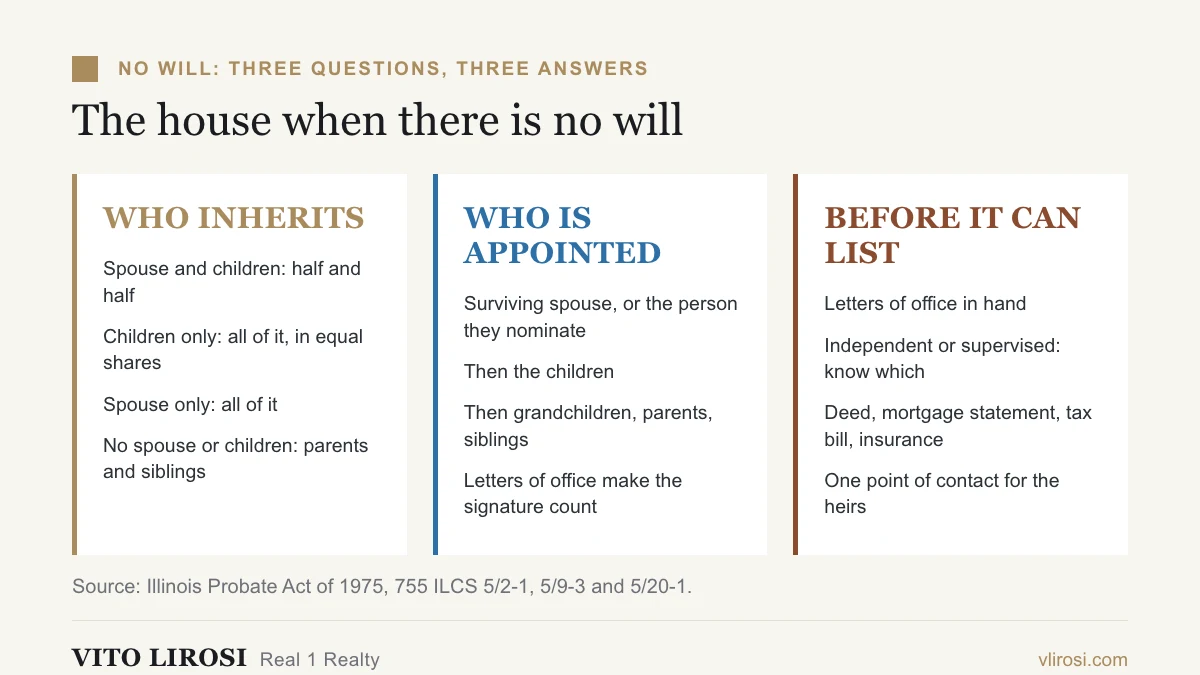
The statute answers the first column. The court answers the second. The third is on the family.
Four heirs, one house, one roof
Inheriting a fraction of an estate and co-owning a house are different situations, and the order matters. While the estate is open, the administrator, not the heirs, takes possession of the real estate, collects any rent, keeps the building in repair and pays the taxes and the mortgage from estate funds. The heirs are people waiting for a distribution. When the estate sells the house, the administrator signs one deed and the heirs receive their shares in money. For four heirs with four opinions that is almost always the cleaner path.
The other path is distributing the house itself, so that the heirs own it together after the estate closes. Then every owner holds an undivided share, every owner signs when it sells, and every owner has to agree to a price. If one heir wants to keep the house, that heir buys the others out at a value everyone accepts, and a neutral valuation is what keeps that number from becoming a family argument. How I get a group of heirs to one as-is number and one point of contact is in how to sell an inherited house in Illinois.
Ask your attorney how title will read if the house is distributed rather than sold; that answer is the number of signatures a future sale will need.
What the house is doing in the meantime
Section 20-1 has the administrator take possession of the house during administration and, while holding it, carry a short list of duties: keep it in tenantable repair, pay the taxes, mortgages and liens as they come due, and the option to insure it and spend what is reasonable to preserve it. Who pays those bills, and how an heir who fronts money gets it back, is covered in who pays property taxes on a house in probate. What happens to the homeowners policy once the house sits empty, and what to tell the carrier, is in vacant house insurance during probate.
The same section protects an heir who lives there. The administrator may not take possession of the part of the house an heir occupies as a residence unless the court finds it necessary, for example to pay claims or to preserve the property. A sale with a family member living in the house needs a move-out plan agreed early, because the listing date depends on it.
What does an administrator need to list?
When a family calls me after an appointment, this is what I ask them to bring to the first meeting. Most of it comes from the attorney.
- Certified copies of the letters of office. Title companies and the buyer's attorney will each want one.
- The court order that shows whether the estate is independent or supervised.
- A certified death certificate.
- The recorded deed, to confirm the house is in the estate and to see exactly how title reads.
- The most recent mortgage statement and the most recent property tax bill.
- The homeowners insurance declarations page, and whether the carrier has been told the house is empty.
- Keys, garage and alarm codes, and the name of anyone still living there.
- One heir named as the point of contact for the others.
One document that does not belong on the list is the small estate affidavit. Under section 25-1 the affidavit moves personal property only, up to $150,000 excluding most vehicles registered with the Secretary of State, and only when no letters of office are outstanding or expected. Real estate is not personal property. A house never transfers on an affidavit, so a family that was told the estate was small enough to skip probate still needs letters for the house, or a deed that already carries it outside probate.
How I help when there is no will
Dying without a will in Illinois leaves the house in the hands of an administrator who did not ask for the job and a group of heirs who each own a slice of it. My part starts the day the letters issue and often before, when the family wants to know what the house will need and what it might bring. I read the house the way an inspector does before it lists, so the estate prices to condition instead of to hope, and I work as a probate real estate agent who coordinates the sale with your attorney from the petition to the closing. Families in Arlington Heights have a page written for that town. In Cook County the estate is filed with the Probate Division at the Daley Center; your attorney handles the filing, and I keep the sale on the court's clock.
No will, a house to sell, and a lot of questions?
Tell me where the estate stands. I will tell you what the house likely needs, what to gather before the first showing, and what the timeline looks like from here.
Ask Vito About the HouseGeneral information from a Realtor and licensed home inspector with a professional background in residential appraisal. It is not legal or tax advice. Statutes are quoted as read on October 7, 2026, and how they apply to your family is a question for your attorney.