Vacant House Insurance During Probate, and Keeping the House Standing While It Sits Empty
The policy on an inherited house was written for someone living in it. Once the house is empty, the clock is running on the coverage and on the plumbing. Here is what to do in the first week, and every week after.
By Vito LiRosi · Realtor and licensed home inspector · September 2026
An empty house is a different risk to a carrier, and to the estate.
A homeowners policy changes what it covers once the house is unoccupied for a set number of days, and the clock started when the house emptied. Call the carrier in week one, decide heat or drained, and walk the house every week with a camera.
- Read the policy, not the declarations page. The vacancy language is in the booklet, and the day count started when the house emptied.
- The representative has the authority. 755 ILCS 5/20-1 lets the representative insure the real estate and make reasonable expenditures to preserve it.
- Heat on or water off. Half measures are how a supply line splits in January and runs for days.
- Keep a dated log and photos. The carrier wants proof the conditions were met, and the buyer's inspector will read the same record.
The funeral is over, the house is empty, and the homeowners policy is still in the name of someone who is no longer alive. Most families assume the house is covered until the estate sells it. Often it is not, or not the way they think. Vacant house insurance during probate is the question I ask executors in our first conversation, before the listing, before the cleanout, before anything else, because the answer decides whether a burst pipe in January is a repair or a loss the heirs absorb.
I am a Realtor and a licensed home inspector, and I walk empty houses in the Northwest suburbs every month. I am not an insurance agent or an attorney. What the estate's policy covers is a question for the carrier, and what the estate may spend is a question for its attorney. What follows is what I see go wrong in empty houses, and the order I would handle it in.
The policy may already treat the house differently
A standard homeowners policy is priced for a house someone lives in. When the house is empty, the risk changes, and most policies say so. The wording varies by carrier and by form, so I will not quote one as if it were the rule, but the shape is consistent: after the house has been unoccupied for a set number of consecutive days, certain kinds of loss are limited or excluded. Vandalism, theft, glass breakage and water damage from frozen pipes are the usual names on that list. The Illinois Department of Insurance's own property insurance consumer guide lists property that is vacant or unoccupied among the risks carriers are excluding or limiting.
The part families miss is that the clock started the day the house emptied, not the day the estate opened. If the owner spent the last months in a hospital or a care setting, the house may already be past whatever window the policy sets before anyone has read the declarations page.
So the first job is to read it. The declarations page names the carrier and the policy form; the policy booklet holds the vacancy language. Find the word "vacant" and the word "unoccupied" and read what follows each one. They are not the same word to a carrier.
The carrier will also want to know who is allowed to act for the estate. When there was no will, that is an administrator the court appoints, and how that appointment works when someone dies without a will in Illinois is worth knowing before the first call.
Vacant house insurance during probate: what to tell the carrier, and when
Call early, and call before the house has been empty for a month if you can. Tell the carrier the owner has died, the house is empty, and an estate is being opened. Get three answers on paper: how the policy treats an unoccupied house, whether the carrier offers a vacancy endorsement or a separate vacant-dwelling policy, and what conditions attach to it.
Who can make that call depends on where the estate stands. Before letters of office issue, the carrier may only talk to a named insured, and the named insured is deceased. Most carriers will still take a notice of death and a request for the policy documents from a family member. Once the representative has letters, the conversation is theirs. The Illinois Probate Act is direct about the authority: under 755 ILCS 5/20-1, unless the will says otherwise, the representative takes possession of the decedent's real estate during administration and, while holding it, shall keep the buildings in tenantable repair, may protect the real estate by insurance, and may make reasonable expenditures necessary to preserve it. A vacancy endorsement and a furnace service call are the plainest examples of that language I know.
Illinois also gives an insured some room when a carrier moves to cancel a fire policy over the condition of the property. Under 215 ILCS 5/143.27, a carrier may not cancel or nonrenew fire and extended coverage on a property that can be repaired without allowing the named insured a reasonable period, never more than ninety days, to fix the defects it names. If a notice like that arrives, hand it to the estate's attorney the same day. The window is short and it starts when the notice is sent.
What a Chicago winter does to an empty house
This is the section I can write from the inspector's side, because I see the results in spring. An occupied house has someone noticing that the furnace stopped at 2 a.m. An empty house has nobody, and the damage compounds for days before anyone opens the door. In order of what costs the most to put right:
- A furnace that stops in a cold snap. Supply lines in exterior walls freeze first, then split, and when the house warms up the water runs until someone shuts the main. Ceilings, floors and cabinets go with it. This is the failure that ends listing dates.
- A sump pump with no power. A Northwest suburbs basement in a February thaw is a sump pump's busiest week. If the pump fails, or the power fails, the basement floods from below and the damage looks like a plumbing loss to a carrier that has already limited water coverage.
- Ice dams on an unheated attic edge. Heat leaking into the attic melts snow that refreezes at the eave, and water backs up under the shingles into the wall. Nobody sees it until the drywall stains.
- A water heater left full in a house that was drained. It freezes, the tank splits, and it has to be replaced before the house can be shown with the water on.
- Gutters and downspouts that were not cleared before the first freeze. Small, cheap, and the start of most of the ice-dam and foundation-seepage stories above.
The decision that drives everything else is heat or no heat. Keep the furnace running and the thermostat set well above freezing, and the plumbing lives. Or shut the water at the main, drain the lines, and accept that the house shows cold. Half measures, a thermostat at the bottom of its range with the water still on, are how I find the split pipe in April.
| Season | What is at risk | The preventable failure | What to do |
|---|---|---|---|
| Late fall | Roof edge, gutters, foundation | Clogged gutters feeding ice dams and seepage | Clear gutters, extend downspouts, check the attic for daylight |
| Early winter | Furnace, supply lines | Furnace stops unnoticed, lines in outside walls freeze | Service the furnace, new filter, thermostat well above freezing, cabinet doors open on exterior walls |
| Deep winter | Whole plumbing system | A split line running for days | Decide: heat kept on, or main shut and lines drained. Weekly visit, every faucet |
| Thaw | Basement | Sump pump fails or loses power | Test the pump, add a battery backup, look at the floor after every warm spell |
| Spring | Roof, grading, windows | Winter damage found late | Walk the exterior, run the water, photograph everything before the first showing |
No cost figures in that table on purpose. What a split line costs depends on how long it ran, and any number I printed would be a guess. Every line in it is cheaper to prevent than to discover.
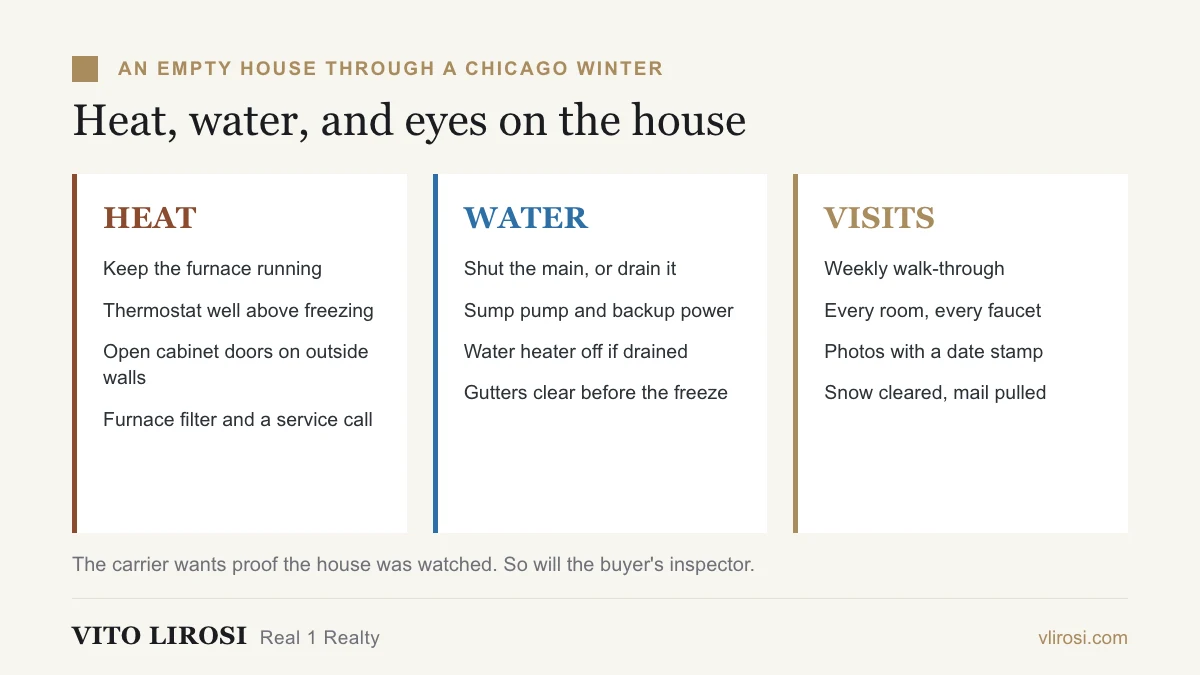
Heat, water and eyes on the house. Miss one and the other two stop mattering.
What conditions does a carrier attach?
A vacancy endorsement or a vacant-dwelling policy usually comes with conditions, and the conditions are where estates get caught. The common ones: heat maintained at or above a stated temperature, or the water system shut off and drained; the house visited and inspected at a stated interval; doors and windows secured; and sometimes a working alarm. A carrier that can show a condition was not met has a reason to deny the loss that condition was written to prevent.
So the estate needs a record that satisfies the carrier before there is a loss. Keep a simple log of every visit: the date, who went, what was checked, and the thermostat reading. Photograph the thermostat, the sump pit and the water meter each time. A dated photo of a thermostat at 58 degrees on the day before the cold snap is worth more than any statement written afterward.
The honest take
Families skip the carrier call because they expect a higher premium, and they are usually right, a vacant-dwelling policy costs more than the homeowners policy it replaces. It is still the cheapest line in the estate's budget. The expensive line is the uninsured loss, and the second most expensive is the month of listing time the repair eats.
What does a walk-through schedule look like?
Weekly, through the heating season, and no less than every two weeks the rest of the year. The visit takes twenty minutes if it is done in the same order every time.
- Outside first. Mail pulled, snow cleared, flyers gone from the door. A house that reads as empty from the street is the one someone tests the back door on.
- Thermostat and furnace. Read the temperature, listen for the blower, glance at the filter.
- Every faucet. Run each one, hot and cold, and look under each sink. A drip you can see is a pipe that has not split yet.
- Basement floor and sump pit. Dry floor, pump cycles when the float lifts.
- Ceilings and the top of every exterior wall. A stain that was not there last week is the whole reason for the visit.
- Photos, then the log. Same angles every week so a change is obvious.
Who does the walking is the estate's choice: a family member nearby, a neighbor, or the agent. I do it for the estates I list because I would rather find the problem than explain it to a buyer's inspector.
Why the record is worth money at the sale
Every buyer will have an inspector in the house, and an inspector reads an empty house for exactly the failures above. A dated log, a furnace service receipt and a set of winter photos answer the questions before they are asked. A house with that record sells as a house that was looked after. A house without it sells as a house that sat.
The receipts also matter to the estate itself. Under the Probate Act, reasonable expenditures to preserve the real estate are the representative's to make, and my guide to who pays the bills on a house in probate covers how a family member who advances them gets repaid. If the house has to be emptied first, the order of operations is in my guide to clearing out a house after a death, and the sale itself is in selling an inherited house in Illinois. If the mortgage on the empty house is already behind, the options are different, and my page on selling ahead of a foreclosure walks through them.
Vacant house insurance during probate is a phone call in week one and a walk-through every week after it. Neither is hard. Both get skipped, because nobody tells the family the policy changed when the house emptied. Now somebody has. When the house is ready to list, working with a probate real estate agent who inspects the house before it goes on the market means the winter is one more thing already handled, whether the house is in Arlington Heights or anywhere across the Northwest suburbs.
Holding an empty house through the winter
Send me the address and where the estate stands. I will walk the house, tell you what it needs before the cold, and help you line up the sale for when the estate is ready.
Ask Vito About an Empty HouseGeneral information for families handling an Illinois estate, from a Realtor and licensed home inspector, not legal or insurance advice. Policy terms differ by carrier and by form; read your own declarations page and confirm coverage with your carrier and your estate's attorney.